Levorphanol: Difference between revisions
CSV import |
CSV import |
||
| Line 34: | Line 34: | ||
[[Category:Analgesics]] | [[Category:Analgesics]] | ||
[[Category:Morphinans]] | [[Category:Morphinans]] | ||
<gallery> | |||
File:Levorphanol2DCSD2.svg|Levorphanol 2D Structure | |||
File:Levorphanol molecule ball.png|Levorphanol Molecule Ball Model | |||
File:Levorphanol and dextrorphan.png|Levorphanol and Dextrorphan | |||
</gallery> | |||
Latest revision as of 01:09, 20 February 2025
An opioid medication used for pain management
| Levorphanol | |
|---|---|

| |
| INN | |
| Drug class | |
| Routes of administration | |
| Pregnancy category | |
| Bioavailability | |
| Metabolism | |
| Elimination half-life | |
| Excretion | |
| Legal status | |
| CAS Number | |
| PubChem | |
| DrugBank | |
| ChemSpider | |
| KEGG | |
Levorphanol is a synthetic opioid used primarily in the management of moderate to severe pain. It is known for its potent analgesic properties and is often utilized in cases where other pain management strategies are ineffective.
Pharmacology[edit]
Levorphanol is a morphinan derivative and acts as an agonist at the mu-opioid receptor, which is responsible for its analgesic effects. It also has activity at the kappa-opioid receptor and delta-opioid receptor, contributing to its efficacy in pain relief. Additionally, levorphanol inhibits the reuptake of norepinephrine and serotonin, which may enhance its analgesic properties.
Medical uses[edit]
Levorphanol is primarily indicated for the treatment of moderate to severe pain. It is particularly useful in chronic pain conditions where other opioids may not be effective. Due to its long half-life, levorphanol can provide sustained pain relief with less frequent dosing compared to other opioids.
Side effects[edit]
Common side effects of levorphanol include nausea, vomiting, constipation, drowsiness, and dizziness. Like other opioids, it carries a risk of respiratory depression, especially at higher doses or when combined with other central nervous system depressants.
History[edit]
Levorphanol was first synthesized in the 1940s and has been used clinically since the 1950s. It was developed as part of efforts to find effective analgesics with fewer side effects than morphine.
Stereochemistry[edit]
Levorphanol is the levorotatory isomer of racemorphan, with the dextrorotatory isomer being dextrorphan, which is an antitussive and NMDA receptor antagonist. The stereochemistry of levorphanol contributes to its potent opioid activity.
Related pages[edit]
-
 Levorphanol 2D Structure
 -
 Levorphanol Molecule Ball Model
 -
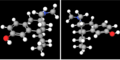 Levorphanol and Dextrorphan


