Anthropometry: Difference between revisions
From WikiMD's Medical Encyclopedia
mNo edit summary |
CSV import Tags: mobile edit mobile web edit |
||
| Line 50: | Line 50: | ||
[[Category:Physiology]] | [[Category:Physiology]] | ||
[[Category:Racism]] | [[Category:Racism]] | ||
<gallery> | |||
File:Computer_Workstation_Variables_cleanup.png|Anthropometry | |||
File:Galton_at_Bertillon's_(1893).jpg|Francis Galton at Bertillon's laboratory, 1893 | |||
File:example_insole_pressure_device.jpg|Insole pressure measurement device | |||
File:example_foot_pressure_measurement_device.jpg|Foot pressure measurement device | |||
File:Fingerprints_taken_by_William_James_Herschel_1859-1860.jpg|Fingerprints taken by William James Herschel, 1859-1860 | |||
File:Iris_Recognition.ogv|Iris recognition | |||
File:Defense.gov_photo_essay_090728-A-2946F-124.jpg|Anthropometry | |||
</gallery> | |||
Latest revision as of 12:23, 18 February 2025
Anthropometry is the study of measurement and proportions of the human body.
Alphonse Bertillon and Criminology[edit]
Anthropometry was first created by Alphonse Bertillon (April 24, 1853 – February 13, 1914). He was born in Paris, France. When he became a police officer, he created Anthropometry so that criminals could be easily identified. The system helped the police to get through many criminal records quicker. Having produced a set of characteristics of criminals, it became easier for the police to identify offenders.
Anthropometric measurements[edit]
The system involves 10 measurements:
- Height
- Stretch
- Bust
- Head length (crown to forehead)
- Head width (temple to temple)
- Cheek width
- Ear length (both left and right)
- Middle finger
- Foot length
- Cubit (length from elbow to middle finger)
References[edit]
- Burnett, “Introduction to Human factors, Human anatomy and Biomechanics”. Web.10 Dec.2011
- "Anthropometry." Ergonomics4schools. Web. 10 Dec. 2011
- Webster's Online Dictionary - Web. 11 Dec. 2011
 | |
|---|---|
 |
 |
| Human regional anatomy | ||||||||||
|---|---|---|---|---|---|---|---|---|---|---|
|
| Human systems and organs | ||||||||||||||
|---|---|---|---|---|---|---|---|---|---|---|---|---|---|---|
|
-
 Anthropometry
 -
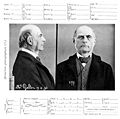 Francis Galton at Bertillon's laboratory, 1893
 -
 Insole pressure measurement device
 -
 Foot pressure measurement device
 -
 Fingerprints taken by William James Herschel, 1859-1860
 -
 Iris recognition
 -
 Anthropometry

.jpg)


