Shapiro syndrome: Difference between revisions
No edit summary Tag: visualeditor-wikitext |
CSV import |
||
| Line 97: | Line 97: | ||
{{nervoussystem-disease-stub}} | {{nervoussystem-disease-stub}} | ||
== Shapiro syndrome == | |||
<gallery> | |||
File:Human Body Temperature Scale.jpg|Human Body Temperature Scale | |||
File:Hyperhidrosis.jpg|Hyperhidrosis | |||
File:Corpus callosum.gif|Corpus callosum | |||
</gallery> | |||
Latest revision as of 01:37, 20 February 2025
| Shapiro syndrome | |
|---|---|
| [[File:|250px|alt=|]] | |
| Synonyms | Spontaneous periodic hypothermia |
| Pronounce | |
| Field | neurology |
| Symptoms | |
| Complications | |
| Onset | |
| Duration | |
| Types | |
| Causes | |
| Risks | |
| Diagnosis | |
| Differential diagnosis | |
| Prevention | |
| Treatment | |
| Medication | |
| Prognosis | |
| Frequency | |
| Deaths | |
Shapiro syndrome is an extremely rare disorder consisting of paroxysmal hypothermia (due to hypothalamic dysfunction of thermoregulation), hyperhydrosis (sweating), and agenesis of the corpus callosum with onset typically on adulthood. The disease affects about 50 people worldwide. The duration and frequency of the episodes vary from person to person, with some episodes lasting hours to weeks and occurring from hours to years. Very little is known about the disease due to the small number of people affected.<ref>Shapiro Syndrome, Genetic and Rare Diseases Information Center (GARD), National Institutes of Health</ref>
Epidemiology[edit]
The prevalence of Shapiro syndrome is unknown. To date, over 50 cases have been reported in the medical literature.
Cause[edit]
The cause of the condition is currently unknown; however, suggested possible mechanisms include hypothalamic dysfunction, neurochemical abnormalities, inflammatory processes, and epileptic activity.
Signs and symptoms[edit]
- Shapiro syndrome generally consists of three findings: spontaneous periodic hypothermia, excessive sweating (hyperhidrosis), and agenesis of the corpus callosum.
- A variant form occurs without agenesis of corpus callosum.
- Additional symptoms may include nausea and vomiting; a sense of weakness, incoordination and gait unsteadiness; drowsiness, mild bradycardia; and rarely, excessive amounts of urine (polyuria) and excessive thirst (polydipsia).
- Episodes of hypothermia and hyperhidrosis may last for hours to weeks and recur for hours to years.
Clinical presentation[edit]
For most diseases, symptoms will vary from person to person. People with the same disease may not have all the symptoms listed.
80%-99% of people have these symptoms
- Ataxia
- Fatigue(Tired)
- Gait disturbance(Abnormal gait)
- Hyperhidrosis(Excessive sweating)
- Hypothermia(Abnormally low body temperature)
- Nausea and vomiting
- Pallor
30%-79% of people have these symptoms
- Arrhythmia(Abnormal heart rate)
- Reduced consciousness/confusion(Disturbances of consciousness)
- Seizure
- Sleep disturbance(Difficulty sleeping)
- Tremor
5%-29% of people have these symptoms
- Abnormal pattern of respiration(Abnormal respiratory patterns)
- Aplasia/Hypoplasia of the corpus callosum
- Diarrhea(Watery stool)
- Skin rash
Diagnosis[edit]
Brain magnetic resonance imaging demonstrates corpus callosum agenesis with colpocephaly.<ref>Mathur S, Mathur A, Dubey T, Jain S, Mathur S, Agarwal H, Kulshrestha M, Jangid R, Ram C. Shapiro syndrome. J Assoc Physicians India. 2013 Jun;61(6):418-20. PMID: 24640213.</ref>.
Treatment[edit]
- Evaluating effective treatment options for Shapiro syndrome can be difficult because of the limited number of diagnosed cases, the periodic nature of the disease, and other factors. Nonetheless, the following have been attempted and have resulted in varying levels of success: oxcarbazepine, carbamazepine, clonidine, cyproheptadine, glycopyrrolate, bromocriptine, chlorpromazine, beta blockers, or sympathectomy.
- It is recommended that treatment options be discussed with a health care professional. Only a patient's personal health care provider can determine the appropriate course of treatment.
References[edit]
<references group="" responsive="1"></references>
<references />
Further reading[edit]
- "Shapiro syndrome" Shenoy C. QJM. 2008 Jan;101(1):61-2.
- "Shapiro syndrome with hypothalamic hypothyroidism" Arkader R, Takeuchi CA. Arq Neuropsiquiatr. 2008 Jun;66(2B):418-9.
- "Subtotal corpus callosum agenesis with recurrent hyperhidrosis-hypothermia (Shapiro syndrome)" Tambasco N, Corea F, Bocola V. Neurology. 2005 Jul 12;65(1):124.
External links[edit]
_(14784117803).jpg)
Shapiro syndrome[edit]
-
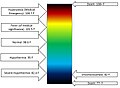 Human Body Temperature Scale
 -
 Hyperhidrosis
 -
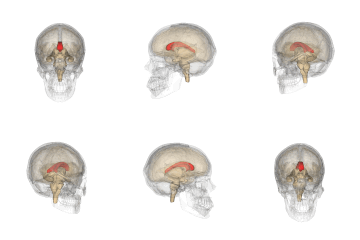 Corpus callosum


