Culture of Nepal: Difference between revisions
CSV import |
No edit summary |
||
| Line 1: | Line 1: | ||
'''Culture of Nepal''' is rich and diverse, reflecting the country's unique blend of [[ethnic groups]], [[religions]], and traditions. From [[art]] and [[architecture]] to [[music]] and [[dance]], Nepal's cultural heritage is a source of pride for its people. In this article, we will explore various aspects of Nepali culture, including its [[festivals]], [[cuisine]], and [[traditional attire]]. | |||
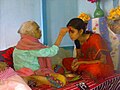
[[File:Dashain_Tika_02.JPG|Dashain Tika | |||
File:Women_in_cultural_costume_at_Ubhauli_Kirati_festival_2017_at_Gough_Whitlam_Park,_Earlwood.jpg|Women in cultural costume at Ubhauli Kirati festival 2017|thumb]] | |||
[[File:Nepali_culture.JPG|Nepali culture|thumb]] | |||
[[File:Nepali_Hindu_Wedding_(34).jpg|Nepali Hindu Wedding|thumb]] | |||
[[File:A_Buddhist_Monastery_Nepal.jpg|A Buddhist Monastery Nepal|thumb]] | |||
=== Festivals === | === Festivals === | ||
Nepal is known for its vibrant and colorful festivals, which are celebrated throughout the year. One of the most important festivals is '''Dashain''', a 15-day long celebration that marks the victory of good over evil. During Dashain, people gather with their families and friends, exchange gifts, and indulge in delicious traditional food. | Nepal is known for its vibrant and colorful [[festivals]], which are celebrated throughout the year. One of the most important festivals is '''Dashain''', a 15-day long celebration that marks the victory of good over evil. During Dashain, people gather with their [[families]] and [[friends]], exchange gifts, and indulge in delicious traditional food. | ||
Another significant festival is '''Tihar''', also known as the Festival of Lights. It is a five-day long celebration that honors various Hindu deities, including the goddess of wealth, Laxmi. During Tihar, houses are decorated with oil lamps, and people participate in cultural dances and music performances. | Another significant festival is '''Tihar''', also known as the [[Festival of Lights]]. It is a five-day long celebration that honors various [[Hindu deities]], including the goddess of wealth, [[Laxmi]]. During Tihar, houses are decorated with oil lamps, and people participate in cultural [[dances]] and [[music performances]]. | ||
=== Cuisine === | === Cuisine === | ||
Nepali cuisine is a delightful fusion of flavors and spices. The staple food of Nepal is '''dal bhat''', a lentil soup served with rice and a variety of side dishes. Other popular dishes include '''momos''', which are steamed or fried dumplings filled with meat or vegetables, and '''gundruk''', a fermented leafy green vegetable. | Nepali [[cuisine]] is a delightful fusion of flavors and spices. The staple food of Nepal is '''dal bhat''', a [[lentil]] soup served with [[rice]] and a variety of [[side dishes]]. Other popular dishes include '''momos''', which are steamed or fried [[dumplings]] filled with [[meat]] or [[vegetables]], and '''gundruk''', a fermented leafy green [[vegetable]]. | ||
Nepal is also famous for its unique beverages, such as '''chiya''', a spiced milk tea, and '''raksi''', a traditional distilled alcoholic drink. These culinary delights reflect the country's diverse geography and cultural influences. | Nepal is also famous for its unique [[beverages]], such as '''chiya''', a spiced milk tea, and '''raksi''', a traditional distilled alcoholic drink. These culinary delights reflect the country's diverse [[geography]] and cultural influences. | ||
=== Traditional Attire === | === Traditional Attire === | ||
The traditional attire of Nepal varies across different ethnic groups. One of the most well-known traditional outfits is the '''daura suruwal''', worn by men. It consists of a knee-length shirt called ''daura'' and loose trousers called ''suruwal''. Women often wear a '''sari''', a long piece of fabric draped around the body, or a '''kurta''', a long tunic paired with leggings. | The traditional attire of Nepal varies across different [[ethnic groups]]. One of the most well-known traditional outfits is the '''daura suruwal''', worn by men. It consists of a knee-length shirt called ''daura'' and loose trousers called ''suruwal''. Women often wear a '''sari''', a long piece of fabric draped around the body, or a '''kurta''', a long tunic paired with [[leggings]]. | ||
=== Art and Architecture === | === Art and Architecture === | ||
Nepal is renowned for its exquisite art and architecture, particularly in the Kathmandu Valley. The '''Pashupatinath Temple''', a UNESCO World Heritage Site, is a prime example of Nepali architecture. It is dedicated to Lord Shiva and attracts thousands of pilgrims and tourists every year. | Nepal is renowned for its exquisite [[art]] and [[architecture]], particularly in the [[Kathmandu Valley]]. The '''[[Pashupatinath Temple]]''', a [[UNESCO World Heritage Site]], is a prime example of Nepali architecture. It is dedicated to [[Lord Shiva]] and attracts thousands of [[pilgrims]] and [[tourists]] every year. | ||
Another notable architectural marvel is the '''Boudhanath Stupa''', one of the largest Buddhist stupas in the world. It is a sacred site for Buddhists and a symbol of peace and harmony. | Another notable architectural marvel is the '''[[Boudhanath Stupa]]''', one of the largest Buddhist [[stupas]] in the world. It is a sacred site for [[Buddhists]] and a symbol of [[peace]] and [[harmony]]. | ||
=== Conclusion === | === Conclusion === | ||
The culture of Nepal is a tapestry of traditions, festivals, cuisine, and art that has been passed down through generations. It is a reflection of the country's rich history and diverse ethnic groups. Exploring the cultural heritage of Nepal is a fascinating journey that offers insights into the vibrant and unique aspects of this beautiful nation. | The culture of Nepal is a tapestry of [[traditions]], [[festivals]], [[cuisine]], and [[art]] that has been passed down through generations. It is a reflection of the country's rich [[history]] and diverse [[ethnic groups]]. Exploring the cultural heritage of Nepal is a fascinating journey that offers insights into the vibrant and unique aspects of this beautiful nation. | ||
== More images == | |||
<gallery> | <gallery> | ||
File:Dashai.jpg|Dashai | File:Dashai.jpg|Dashai | ||
File:Messe-09.JPG|Messe | File:Messe-09.JPG|Messe | ||
| Line 50: | Line 42: | ||
File:Narayangarh-52.JPG|Narayangarh | File:Narayangarh-52.JPG|Narayangarh | ||
</gallery> | </gallery> | ||
[[Category:Cultural Heritage]] | |||
[[Category:Festivals in Nepal]] | |||
[[Category:Nepali Cuisine]] | |||
[[Category:Traditional Attire]] | |||
[[Category:Art and Architecture]] | |||
Latest revision as of 19:47, 7 May 2025
Culture of Nepal is rich and diverse, reflecting the country's unique blend of ethnic groups, religions, and traditions. From art and architecture to music and dance, Nepal's cultural heritage is a source of pride for its people. In this article, we will explore various aspects of Nepali culture, including its festivals, cuisine, and traditional attire.


.jpg)

Festivals[edit]
Nepal is known for its vibrant and colorful festivals, which are celebrated throughout the year. One of the most important festivals is Dashain, a 15-day long celebration that marks the victory of good over evil. During Dashain, people gather with their families and friends, exchange gifts, and indulge in delicious traditional food.
Another significant festival is Tihar, also known as the Festival of Lights. It is a five-day long celebration that honors various Hindu deities, including the goddess of wealth, Laxmi. During Tihar, houses are decorated with oil lamps, and people participate in cultural dances and music performances.
Cuisine[edit]
Nepali cuisine is a delightful fusion of flavors and spices. The staple food of Nepal is dal bhat, a lentil soup served with rice and a variety of side dishes. Other popular dishes include momos, which are steamed or fried dumplings filled with meat or vegetables, and gundruk, a fermented leafy green vegetable.
Nepal is also famous for its unique beverages, such as chiya, a spiced milk tea, and raksi, a traditional distilled alcoholic drink. These culinary delights reflect the country's diverse geography and cultural influences.
Traditional Attire[edit]
The traditional attire of Nepal varies across different ethnic groups. One of the most well-known traditional outfits is the daura suruwal, worn by men. It consists of a knee-length shirt called daura and loose trousers called suruwal. Women often wear a sari, a long piece of fabric draped around the body, or a kurta, a long tunic paired with leggings.
Art and Architecture[edit]
Nepal is renowned for its exquisite art and architecture, particularly in the Kathmandu Valley. The Pashupatinath Temple, a UNESCO World Heritage Site, is a prime example of Nepali architecture. It is dedicated to Lord Shiva and attracts thousands of pilgrims and tourists every year.
Another notable architectural marvel is the Boudhanath Stupa, one of the largest Buddhist stupas in the world. It is a sacred site for Buddhists and a symbol of peace and harmony.
Conclusion[edit]
The culture of Nepal is a tapestry of traditions, festivals, cuisine, and art that has been passed down through generations. It is a reflection of the country's rich history and diverse ethnic groups. Exploring the cultural heritage of Nepal is a fascinating journey that offers insights into the vibrant and unique aspects of this beautiful nation.
More images[edit]
-
 Dashai
 -
 Messe
Messe -
 British Museum Asia
 -
 Nepal Woman
 -
 Nepali Hindu Wedding
 -
 Nepali Hindu groom
 -
 Nepali Hindu Wedding
 -
 Narayangarh


.jpg)

.jpg)

