Anatomical terms of neuroanatomy: Difference between revisions
CSV import |
CSV import |
||
| Line 4: | Line 4: | ||
File:Sulci_Gyri_Fundi_in_section_of_Human_brain.jpg|Sulci, gyri, and fundi in a section of the human brain | File:Sulci_Gyri_Fundi_in_section_of_Human_brain.jpg|Sulci, gyri, and fundi in a section of the human brain | ||
</gallery> | </gallery> | ||
== Anatomical Terms of Neuroanatomy == | |||
Anatomical terms of neuroanatomy are used to describe the location and function of structures within the [[nervous system]]. These terms are essential for understanding the complex organization of the brain, spinal cord, and peripheral nerves. This article provides an overview of the key anatomical terms used in neuroanatomy. | |||
=== Basic Orientation Terms === | |||
In neuroanatomy, orientation terms are used to describe the position of structures relative to each other. These include: | |||
* '''Rostral''': Toward the front or nose. In the brain, rostral indicates a direction toward the frontal lobes. | |||
* '''Caudal''': Toward the back or tail. In the brain, caudal refers to a direction toward the occipital lobes. | |||
* '''Dorsal''': Toward the top or back. In the brain, dorsal indicates a direction toward the top of the head. | |||
* '''Ventral''': Toward the bottom or belly. In the brain, ventral refers to a direction toward the base of the skull. | |||
* '''Medial''': Toward the midline of the body. | |||
* '''Lateral''': Away from the midline of the body. | |||
=== Planes of Section === | |||
Understanding the planes of section is crucial for interpreting [[neuroimaging]] and anatomical diagrams. The main planes are: | |||
* '''Sagittal plane''': A vertical plane that divides the body into right and left parts. A midsagittal section divides the brain into equal right and left halves. | |||
* '''Coronal plane''': A vertical plane that divides the body into anterior (front) and posterior (back) parts. | |||
* '''Horizontal plane''': A plane that divides the body into superior (upper) and inferior (lower) parts. Also known as the transverse plane. | |||
=== Major Divisions of the Brain === | |||
The brain is divided into several major regions, each with specific functions: | |||
* '''[[Cerebrum]]''': The largest part of the brain, responsible for higher brain functions such as thought, action, and emotion. It is divided into two hemispheres and further into lobes: frontal, parietal, temporal, and occipital. | |||
* '''[[Cerebellum]]''': Located under the cerebrum, it is responsible for coordination and balance. | |||
* '''[[Brainstem]]''': Connects the brain to the spinal cord and controls basic life functions such as breathing, heart rate, and blood pressure. It includes the midbrain, pons, and medulla oblongata. | |||
=== Functional Areas === | |||
The brain contains several functional areas, each associated with specific tasks: | |||
* '''[[Motor cortex]]''': Located in the frontal lobe, it controls voluntary movements. | |||
* '''[[Sensory cortex]]''': Located in the parietal lobe, it processes sensory information from the body. | |||
* '''[[Broca's area]]''': Involved in speech production, located in the frontal lobe. | |||
* '''[[Wernicke's area]]''': Involved in language comprehension, located in the temporal lobe. | |||
=== Neural Pathways === | |||
Neural pathways are bundles of [[axons]] that connect different parts of the nervous system. Key pathways include: | |||
* '''[[Corticospinal tract]]''': Carries motor signals from the cerebral cortex to the spinal cord. | |||
* '''[[Spinothalamic tract]]''': Transmits sensory information from the spinal cord to the thalamus. | |||
* '''[[Corpus callosum]]''': A large bundle of nerve fibers that connects the two cerebral hemispheres. | |||
== Related Pages == | |||
* [[Nervous system]] | |||
* [[Central nervous system]] | |||
* [[Peripheral nervous system]] | |||
* [[Neuroanatomy]] | |||
* [[Brain]] | |||
* [[Spinal cord]] | |||
{{Neuroanatomy}} | |||
[[Category:Neuroanatomy]] | |||
Latest revision as of 00:37, 19 February 2025
-
 Anatomical axes alterations in the human brain
 -
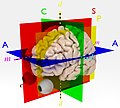 Anatomical planes with letter annotations in the human brain
 -
 Sulci, gyri, and fundi in a section of the human brain


Anatomical Terms of Neuroanatomy[edit]
Anatomical terms of neuroanatomy are used to describe the location and function of structures within the nervous system. These terms are essential for understanding the complex organization of the brain, spinal cord, and peripheral nerves. This article provides an overview of the key anatomical terms used in neuroanatomy.
Basic Orientation Terms[edit]
In neuroanatomy, orientation terms are used to describe the position of structures relative to each other. These include:
- Rostral: Toward the front or nose. In the brain, rostral indicates a direction toward the frontal lobes.
- Caudal: Toward the back or tail. In the brain, caudal refers to a direction toward the occipital lobes.
- Dorsal: Toward the top or back. In the brain, dorsal indicates a direction toward the top of the head.
- Ventral: Toward the bottom or belly. In the brain, ventral refers to a direction toward the base of the skull.
- Medial: Toward the midline of the body.
- Lateral: Away from the midline of the body.
Planes of Section[edit]
Understanding the planes of section is crucial for interpreting neuroimaging and anatomical diagrams. The main planes are:
- Sagittal plane: A vertical plane that divides the body into right and left parts. A midsagittal section divides the brain into equal right and left halves.
- Coronal plane: A vertical plane that divides the body into anterior (front) and posterior (back) parts.
- Horizontal plane: A plane that divides the body into superior (upper) and inferior (lower) parts. Also known as the transverse plane.
Major Divisions of the Brain[edit]
The brain is divided into several major regions, each with specific functions:
- Cerebrum: The largest part of the brain, responsible for higher brain functions such as thought, action, and emotion. It is divided into two hemispheres and further into lobes: frontal, parietal, temporal, and occipital.
- Cerebellum: Located under the cerebrum, it is responsible for coordination and balance.
- Brainstem: Connects the brain to the spinal cord and controls basic life functions such as breathing, heart rate, and blood pressure. It includes the midbrain, pons, and medulla oblongata.
Functional Areas[edit]
The brain contains several functional areas, each associated with specific tasks:
- Motor cortex: Located in the frontal lobe, it controls voluntary movements.
- Sensory cortex: Located in the parietal lobe, it processes sensory information from the body.
- Broca's area: Involved in speech production, located in the frontal lobe.
- Wernicke's area: Involved in language comprehension, located in the temporal lobe.
Neural Pathways[edit]
Neural pathways are bundles of axons that connect different parts of the nervous system. Key pathways include:
- Corticospinal tract: Carries motor signals from the cerebral cortex to the spinal cord.
- Spinothalamic tract: Transmits sensory information from the spinal cord to the thalamus.
- Corpus callosum: A large bundle of nerve fibers that connects the two cerebral hemispheres.
Related Pages[edit]
| Neuroanatomy | ||||||||||
|---|---|---|---|---|---|---|---|---|---|---|
This neuroanatomy-related article is a stub.
|
