Amentoflavone: Difference between revisions
CSV import |
CSV import |
||
| Line 8: | Line 8: | ||
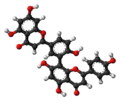
File:Amentoflavone_molecule_ball.png|Amentoflavone molecule ball-and-stick model | File:Amentoflavone_molecule_ball.png|Amentoflavone molecule ball-and-stick model | ||
</gallery> | </gallery> | ||
== Amentoflavone == | |||
'''Amentoflavone''' is a naturally occurring [[biflavonoid]] compound found in several plant species. It is known for its potential [[pharmacological]] properties and has been the subject of various scientific studies. | |||
=== Chemical Structure === | |||
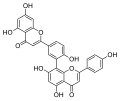
Amentoflavone is a dimeric flavonoid, meaning it consists of two flavonoid units linked together. Specifically, it is a biflavonoid composed of two [[apigenin]] units. The chemical structure of amentoflavone can be described as 8-[5-(5,7-dihydroxy-4-oxo-4H-chromen-2-yl)oxy-4-hydroxy-2-(4-hydroxyphenyl)chromen-7-yl]-4H-chromen-4-one. | |||
=== Natural Sources === | |||
Amentoflavone is found in various plant species, including members of the [[Selaginellaceae]] family, such as ''[[Selaginella tamariscina]]'' and ''[[Selaginella lepidophylla]]''. It is also present in other plants like ''[[Ginkgo biloba]]'' and ''[[Hypericum perforatum]]'' (commonly known as St. John's Wort). | |||
=== Pharmacological Properties === | |||
Amentoflavone has been studied for its potential [[biological activity|biological activities]], which include: | |||
* '''Antioxidant Activity''': Amentoflavone exhibits antioxidant properties, which help in neutralizing [[free radicals]] and reducing oxidative stress. | |||
* '''Anti-inflammatory Effects''': It has been shown to possess anti-inflammatory effects by inhibiting the production of pro-inflammatory cytokines. | |||
* '''Antiviral Activity''': Some studies suggest that amentoflavone may have antiviral properties, potentially inhibiting the replication of certain viruses. | |||
* '''Neuroprotective Effects''': Amentoflavone has been investigated for its neuroprotective effects, which may be beneficial in the treatment of neurodegenerative diseases. | |||
* '''Anticancer Potential''': Research indicates that amentoflavone may have anticancer properties, as it can induce apoptosis in certain cancer cell lines. | |||
=== Mechanism of Action === | |||
The mechanisms by which amentoflavone exerts its effects are varied and complex. It is known to interact with multiple molecular targets, including: | |||
* '''Enzyme Inhibition''': Amentoflavone can inhibit various enzymes, such as [[cyclooxygenase]] and [[lipoxygenase]], which are involved in inflammatory pathways. | |||
* '''Receptor Modulation''': It may modulate the activity of certain receptors, including [[GABA]] receptors, which are involved in [[neurotransmission]]. | |||
* '''Signal Transduction Pathways''': Amentoflavone can influence signal transduction pathways, such as the [[MAPK/ERK pathway]], which plays a role in cell proliferation and survival. | |||
=== Safety and Toxicity === | |||
While amentoflavone has shown promising pharmacological activities, its safety and toxicity profile in humans is not fully established. Further research is needed to determine its potential therapeutic applications and any adverse effects. | |||
== Related Pages == | |||
* [[Flavonoid]] | |||
* [[Apigenin]] | |||
* [[Selaginella]] | |||
* [[Ginkgo biloba]] | |||
* [[Hypericum perforatum]] | |||
{{Flavonoids}} | |||
[[Category:Biflavonoids]] | |||
[[Category:Flavonoids]] | |||
[[Category:Natural phenols]] | |||
Latest revision as of 00:37, 19 February 2025
-
 Amentoflavone
 -
 Amentoflavone molecule ball


Amentoflavone[edit]
-
Amentoflavone chemical structure
-
Amentoflavone molecule ball-and-stick model
Amentoflavone[edit]
Amentoflavone is a naturally occurring biflavonoid compound found in several plant species. It is known for its potential pharmacological properties and has been the subject of various scientific studies.
Chemical Structure[edit]
Amentoflavone is a dimeric flavonoid, meaning it consists of two flavonoid units linked together. Specifically, it is a biflavonoid composed of two apigenin units. The chemical structure of amentoflavone can be described as 8-[5-(5,7-dihydroxy-4-oxo-4H-chromen-2-yl)oxy-4-hydroxy-2-(4-hydroxyphenyl)chromen-7-yl]-4H-chromen-4-one.
Natural Sources[edit]
Amentoflavone is found in various plant species, including members of the Selaginellaceae family, such as Selaginella tamariscina and Selaginella lepidophylla. It is also present in other plants like Ginkgo biloba and Hypericum perforatum (commonly known as St. John's Wort).
Pharmacological Properties[edit]
Amentoflavone has been studied for its potential biological activities, which include:
- Antioxidant Activity: Amentoflavone exhibits antioxidant properties, which help in neutralizing free radicals and reducing oxidative stress.
- Anti-inflammatory Effects: It has been shown to possess anti-inflammatory effects by inhibiting the production of pro-inflammatory cytokines.
- Antiviral Activity: Some studies suggest that amentoflavone may have antiviral properties, potentially inhibiting the replication of certain viruses.
- Neuroprotective Effects: Amentoflavone has been investigated for its neuroprotective effects, which may be beneficial in the treatment of neurodegenerative diseases.
- Anticancer Potential: Research indicates that amentoflavone may have anticancer properties, as it can induce apoptosis in certain cancer cell lines.
Mechanism of Action[edit]
The mechanisms by which amentoflavone exerts its effects are varied and complex. It is known to interact with multiple molecular targets, including:
- Enzyme Inhibition: Amentoflavone can inhibit various enzymes, such as cyclooxygenase and lipoxygenase, which are involved in inflammatory pathways.
- Receptor Modulation: It may modulate the activity of certain receptors, including GABA receptors, which are involved in neurotransmission.
- Signal Transduction Pathways: Amentoflavone can influence signal transduction pathways, such as the MAPK/ERK pathway, which plays a role in cell proliferation and survival.
Safety and Toxicity[edit]
While amentoflavone has shown promising pharmacological activities, its safety and toxicity profile in humans is not fully established. Further research is needed to determine its potential therapeutic applications and any adverse effects.
Related Pages[edit]
| Types of flavonoids | ||||||||||||||||||||||||||||||||||||||
|---|---|---|---|---|---|---|---|---|---|---|---|---|---|---|---|---|---|---|---|---|---|---|---|---|---|---|---|---|---|---|---|---|---|---|---|---|---|---|
|
