DNA nanotechnology: Difference between revisions
CSV import |
CSV import |
||
| (2 intermediate revisions by the same user not shown) | |||
| Line 1: | Line 1: | ||
== DNA Nanotechnology == | |||
'''DNA nanotechnology''' is a branch of [[nanotechnology]] that uses the unique molecular recognition properties of [[DNA]] and other nucleic acids to create self-assembling | '''DNA nanotechnology''' is a branch of [[nanotechnology]] that uses the unique molecular recognition properties of [[DNA]] and other [[nucleic acids]] to create self-assembling [[nanostructures]]. This field exploits the predictable base pairing rules of DNA to design and construct complex structures at the nanoscale. | ||
== | === History === | ||
DNA nanotechnology | The concept of DNA nanotechnology was first introduced by [[Nadrian Seeman]] in the early 1980s. Seeman proposed using DNA to create a lattice for organizing other molecules, which laid the foundation for the development of this field. | ||
== | === Principles === | ||
DNA nanotechnology relies on the specific base pairing interactions between [[adenine]] (A) and [[thymine]] (T), and between [[cytosine]] (C) and [[guanine]] (G). These interactions allow for the precise design of DNA strands that can self-assemble into predetermined structures. | |||
=== Applications === | |||
DNA nanotechnology has a wide range of applications, including: | |||
* **Molecular Computing**: DNA can be used to perform computations by encoding information in the sequence of bases. | |||
* **Drug Delivery**: DNA nanostructures can be designed to carry and release therapeutic agents in a controlled manner. | |||
* **Biosensing**: DNA-based sensors can detect specific molecules or changes in the environment. | |||
* **Structural Biology**: DNA nanostructures can be used to organize proteins and other biomolecules for structural studies. | |||
=== Techniques === | |||
Some of the key techniques used in DNA nanotechnology include: | |||
* **DNA Origami**: A method where a long single strand of DNA is folded into a specific shape with the help of short "staple" strands. | |||
DNA | * **Tile-based Assembly**: Uses small DNA tiles that can self-assemble into larger structures. | ||
* **Hybridization Chain Reaction**: A technique where DNA strands undergo a chain reaction of hybridization to form long chains. | |||
=== Challenges === | |||
Despite its potential, DNA nanotechnology faces several challenges, such as: | |||
* **Stability**: DNA structures can be sensitive to environmental conditions such as temperature and pH. | |||
* **Scalability**: Creating large and complex structures can be difficult and resource-intensive. | |||
* **Cost**: The synthesis of custom DNA sequences can be expensive. | |||
== | === Future Directions === | ||
Research in DNA nanotechnology is ongoing, with efforts focused on improving the stability and scalability of DNA structures, as well as expanding their applications in medicine and materials science. | |||
== References == | |||
* [ | <references/> | ||
* [ | |||
== External Links == | |||
* [DNA Nanotechnology at Wikipedia](https://en.wikipedia.org/wiki/DNA_nanotechnology) | |||
* [Nadrian Seeman's Research Group](http://seemanlab4.chem.nyu.edu/) | |||
{{Nanotechnology}} | {{Nanotechnology}} | ||
{{Molecular | {{Molecular Biology}} | ||
[[Category:Nanotechnology]] | [[Category:Nanotechnology]] | ||
[[Category:Molecular | [[Category:Molecular Biology]] | ||
[[Category:DNA]] | [[Category:DNA]] | ||
[[Category:Emerging Technologies]] | |||
<gallery> | |||
File:DNA tetrahedron white.png|DNA tetrahedron white | |||
File:Escher Depth.jpg|Escher Depth | |||
File:Неподвижная структура Холлидея (англ.).svg|Неподвижная структура Холлидея (англ.) | |||
File:Holliday junction coloured.png|Holliday junction coloured | |||
File:Mao-DX-schematic-2.svg|Mao-DX schematic 2 | |||
File:Mao-DXarray-schematic-small.gif|Mao-DXarray schematic small | |||
File:DX DNA array.png|DX DNA array | |||
File:DNA nanostructures.png|DNA nanostructures | |||
File:SierpinskiTriangle.svg|Sierpinski Triangle | |||
File:Rothemund-DNA-SierpinskiGasket.jpg|Rothemund DNA Sierpinski Gasket | |||
</gallery> | |||
Latest revision as of 06:15, 3 March 2025
DNA Nanotechnology[edit]
DNA nanotechnology is a branch of nanotechnology that uses the unique molecular recognition properties of DNA and other nucleic acids to create self-assembling nanostructures. This field exploits the predictable base pairing rules of DNA to design and construct complex structures at the nanoscale.
History[edit]
The concept of DNA nanotechnology was first introduced by Nadrian Seeman in the early 1980s. Seeman proposed using DNA to create a lattice for organizing other molecules, which laid the foundation for the development of this field.
Principles[edit]
DNA nanotechnology relies on the specific base pairing interactions between adenine (A) and thymine (T), and between cytosine (C) and guanine (G). These interactions allow for the precise design of DNA strands that can self-assemble into predetermined structures.
Applications[edit]
DNA nanotechnology has a wide range of applications, including:
- **Molecular Computing**: DNA can be used to perform computations by encoding information in the sequence of bases.
- **Drug Delivery**: DNA nanostructures can be designed to carry and release therapeutic agents in a controlled manner.
- **Biosensing**: DNA-based sensors can detect specific molecules or changes in the environment.
- **Structural Biology**: DNA nanostructures can be used to organize proteins and other biomolecules for structural studies.
Techniques[edit]
Some of the key techniques used in DNA nanotechnology include:
- **DNA Origami**: A method where a long single strand of DNA is folded into a specific shape with the help of short "staple" strands.
- **Tile-based Assembly**: Uses small DNA tiles that can self-assemble into larger structures.
- **Hybridization Chain Reaction**: A technique where DNA strands undergo a chain reaction of hybridization to form long chains.
Challenges[edit]
Despite its potential, DNA nanotechnology faces several challenges, such as:
- **Stability**: DNA structures can be sensitive to environmental conditions such as temperature and pH.
- **Scalability**: Creating large and complex structures can be difficult and resource-intensive.
- **Cost**: The synthesis of custom DNA sequences can be expensive.
Future Directions[edit]
Research in DNA nanotechnology is ongoing, with efforts focused on improving the stability and scalability of DNA structures, as well as expanding their applications in medicine and materials science.
References[edit]
<references/>
External Links[edit]
- [DNA Nanotechnology at Wikipedia](https://en.wikipedia.org/wiki/DNA_nanotechnology)
- [Nadrian Seeman's Research Group](http://seemanlab4.chem.nyu.edu/)
| Part of a series of articles on |
| Nanotechnology |
|---|
| Impact and applications |
| Nanomaterials |
| Molecular self-assembly |
| Nanoelectronics |
| Nanometrology |
| Molecular nanotechnology |
|
|
| Molecular biology | ||||||||||||||||||||
|---|---|---|---|---|---|---|---|---|---|---|---|---|---|---|---|---|---|---|---|---|
|
-
 DNA tetrahedron white
 -
Escher Depth
-
 Неподвижная структура Холлидея (англ.)
 -
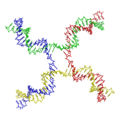 Holliday junction coloured
 -
 Mao-DX schematic 2
 -
 Mao-DXarray schematic small
 -
 DX DNA array
 -
 DNA nanostructures
 -
 Sierpinski Triangle
 -
 Rothemund DNA Sierpinski Gasket

.svg)


