Nanoparticle
Nanoparticles are particles between 1 and 100 nanometres (nm) in size with a surrounding interfacial layer. The interfacial layer is an integral part of nanoscale particles, and it often includes ions, inorganic and organic molecules. Molecules of this layer can be attached to the nanoparticle core, be free in the solution, or can form a structure that includes both.
History[edit]
The history of nanoparticles dates back to the use of colloidal gold nanoparticles by ancient civilizations for vibrant colors in pottery and glass. However, the scientific study of nanoparticles began with a lecture by Michael Faraday on the synthesis of gold nanoparticles in 1857.
Properties[edit]
Nanoparticles exhibit a number of special properties relative to bulk material. For example, the bending of solid materials, plastic deformation, is size-dependent in nanoparticles. Those exceptional properties are due to the large surface area of the particles compared with their volume, and to the high proportion of atoms at the surface.
Synthesis[edit]
There are several methods for creating nanoparticles, including gas condensation, attrition, chemical precipitation, ion implantation, pyrolysis and hydrothermal synthesis.
Applications[edit]
Nanoparticles have a wide variety of potential applications in the fields of biomedical, optical, and electronic fields. They have unique optical properties as they can absorb and emit light of wavelengths much larger than the particles themselves.
Health and safety[edit]
The health impact of nanoparticles is not fully understood, and there is ongoing research to explore the possible effects. Some nanoparticles can be toxic to humans and the environment, and their small size allows them to penetrate most physical barriers in organisms.
See also[edit]
References[edit]

This WikiMD article can only be edited by registered and verified editors. You can log in or register.
Nanoparticle[edit]
-
 Mesoporous Silica Nanoparticle
 -
 2 nm Cluster
 -
 Nanostars
 -
 Comparison of Nanoparticles
 -
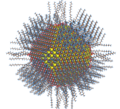 Colloidal Nanoparticle of Lead Sulfide (Selenide) with Complete Passivation
 -
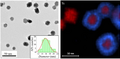 Nanoparticles Grown via Inert Gas Condensation


_with_complete_passivation.png)


Medical Disclaimer: WikiMD is for informational purposes only and is not a substitute for professional medical advice. Content may be inaccurate or outdated and should not be used for diagnosis or treatment. Always consult your healthcare provider for medical decisions. Verify information with trusted sources such as CDC.gov and NIH.gov. By using this site, you agree that WikiMD is not liable for any outcomes related to its content. See full disclaimer.
Credits:Most images are courtesy of Wikimedia commons, and templates, categories Wikipedia, licensed under CC BY SA or similar.
Translate page: - East Asian
中文,
日本,
한국어,
South Asian
हिन्दी,
தமிழ்,
తెలుగు,
Urdu,
ಕನ್ನಡ,
Southeast Asian
Indonesian,
Vietnamese,
Thai,
မြန်မာဘာသာ,
বাংলা
European
español,
Deutsch,
français,
Greek,
português do Brasil,
polski,
română,
русский,
Nederlands,
norsk,
svenska,
suomi,
Italian
Middle Eastern & African
عربى,
Turkish,
Persian,
Hebrew,
Afrikaans,
isiZulu,
Kiswahili,
Other
Bulgarian,
Hungarian,
Czech,
Swedish,
മലയാളം,
मराठी,
ਪੰਜਾਬੀ,
ગુજરાતી,
Portuguese,
Ukrainian

