Bahrain: Difference between revisions
CSV import |
CSV import Tags: mobile edit mobile web edit |
||
| Line 74: | Line 74: | ||
[[Category:Member states of the United Nations]] | [[Category:Member states of the United Nations]] | ||
{{Asia-geo-stub}} | {{Asia-geo-stub}} | ||
==Bahrain== | |||
<gallery> | |||
File:RBNS Sabha (FFG 90) Bahrain.jpg|RBNS Sabha (FFG 90) Bahrain | |||
File:Royal Bahraini Air Force F-16 Block 70 lands at Edwards Air Force Base.jpg|Royal Bahraini Air Force F-16 Block 70 lands at Edwards Air Force Base | |||
</gallery> | |||
Latest revision as of 01:45, 20 February 2025
Country in the Persian Gulf
Bahrain (Arabic: مملكة البحرين ), officially the Kingdom of Bahrain, is a country in the Persian Gulf. The island nation comprises a small archipelago made up of 50 natural islands and an additional 33 artificial islands, centered around Bahrain Island, which makes up around 83% of the country's landmass. Bahrain is situated between the Qatar peninsula and the northeastern coast of Saudi Arabia, to which it is connected by the King Fahd Causeway.
History[edit]
Bahrain has a rich history dating back to ancient times. It was home to the Dilmun civilization, an important trading center linking Mesopotamia and the Indus Valley. The country later came under the influence of the Assyrian Empire, Babylonian Empire, and the Persian Empire. In the 7th century, Bahrain became one of the first regions to convert to Islam. In the 19th century, Bahrain became a British protectorate. It gained independence in 1971 and declared itself a kingdom in 2002. The country has since developed a diversified economy, with banking and tourism being significant sectors.
Government and Politics[edit]
Bahrain is a constitutional monarchy with a parliamentary system. The King of Bahrain is the head of state, and the Prime Minister is the head of government. The National Assembly is a bicameral legislature consisting of the Consultative Council and the Council of Representatives.
Economy[edit]
Bahrain has a high-income economy, with the Bahraini dinar being one of the most valuable currencies in the world. The economy is heavily dependent on oil and natural gas, but the government has been working to diversify it. Key sectors include banking, finance, and tourism. The country is also known for its Bahrain International Circuit, which hosts the annual Bahrain Grand Prix.
Demographics[edit]
Bahrain has a population of approximately 1.7 million people. The majority of the population is Arab, but there are also significant communities of South Asians, Iranians, and Western expatriates. Arabic is the official language, but English, Farsi, and Urdu are also widely spoken.
Culture[edit]
Bahrain has a rich cultural heritage influenced by its history and its position as a trading hub. The country is known for its traditional music, dance, and art. The annual Bahrain International Music Festival and the Spring of Culture festival are significant cultural events.
Education and Health[edit]
Bahrain has a well-developed education system, with free education provided for all citizens. The country also has a robust healthcare system, with both public and private hospitals and clinics.
See also[edit]
References[edit]
<references group="" responsive="1"></references>
   Coordinates:

       26°02
       N°50

Bahrain[edit]
-
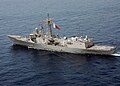 RBNS Sabha (FFG 90) Bahrain
 -
Royal Bahraini Air Force F-16 Block 70 lands at Edwards Air Force Base
_Bahrain.jpg)
- Pages with broken file links
- Articles containing Arabic-language text
- Pages using Lang-xx templates
- Bahrain
- Countries in Asia
- Persian Gulf countries
- Island countries
- Constitutional monarchies
- Arabic-speaking countries and territories
- Member states of the Arab League
- Member states of the Organisation of Islamic Cooperation
- Member states of the United Nations
- Asia geography stubs

.png)


