Crumpet: Difference between revisions
CSV import Tags: mobile edit mobile web edit |
CSV import |
||
| Line 28: | Line 28: | ||
{{food-stub}} | {{food-stub}} | ||
<gallery> | |||
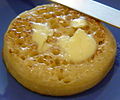
File:Buttered crumpet2.jpg|Crumpet | |||
</gallery> | |||
Latest revision as of 00:51, 20 February 2025
Crumpet is a type of savoury or slightly sweet bread commonly enjoyed in the United Kingdom, Ireland, and in some parts of the Commonwealth. Made from a simple batter of water or milk, flour, and yeast, crumpets are known for their distinctive flat top with deep pores, and a chewy, sponge-like texture. They are traditionally cooked on a griddle or in a special crumpet ring that gives them their characteristic shape.
History[edit]
The origins of the crumpet are somewhat obscure, but it is believed to have been a staple in the British Isles since at least the Anglo-Saxon period. The modern crumpet, distinguished by its holes which are created by the aeration process during cooking, evolved from early forms of flatbreads that were cooked on hot stones. The term "crumpet" itself is thought to have derived from the Old English word "crompid," meaning "curled up," which possibly refers to its slightly curled edges that result from the cooking process.
Ingredients and Preparation[edit]
The basic ingredients of crumpets include wheat flour, baking powder or baking soda as a leavening agent, salt, and water or milk. Some recipes may also include sugar and eggs to enrich the batter. The key to the crumpet's unique texture is the batter's consistency, which is thicker than that of pancake batter but thinner than dough. Yeast is used to ferment the batter, creating the characteristic holes as it cooks.
To prepare crumpets, the batter is poured into greased crumpet rings placed on a hot griddle or frying pan. As the crumpet cooks, the top surface bubbles and sets, while the bottom becomes golden brown. Once the top is set and full of holes, the crumpet is flipped to cook briefly on the other side. Crumpets are typically served warm with butter, jam, or honey.
Cultural Significance[edit]
Crumpets hold a special place in British cuisine and are often associated with tea time, a quintessential British tradition. They are also a popular breakfast item, enjoyed with a variety of toppings. In addition to their culinary role, crumpets have made appearances in British literature and have come to symbolize comfort and homeliness in popular culture.
Variations[edit]
While the traditional crumpet is plain, there are several variations, including whole wheat crumpets, which use whole wheat flour for a nuttier flavor and higher fiber content. Some modern versions incorporate additional ingredients such as cheese, onion, or herbs to create savory variations. In some regions, crumpets may be confused with English muffins; however, the two are distinct, with English muffins being dough-based and cooked to a firmer texture.
Nutritional Information[edit]
Crumpets are relatively low in calories but can be high in carbohydrates due to their flour content. When topped with nutritious ingredients like fresh fruit or natural peanut butter, they can be part of a balanced diet. However, traditional toppings like butter and jam can add additional fat and sugar.
See Also[edit]

-
 Crumpet

