Eastern Time Zone: Difference between revisions
CSV import Tags: mobile edit mobile web edit |
CSV import |
||
| (One intermediate revision by the same user not shown) | |||
| Line 1: | Line 1: | ||
{{Infobox time zone | |||
| name = Eastern Time Zone | |||
| utc_offset = -5 | |||
| utc_offset_DST = -4 | |||
| tz = Eastern Standard Time (EST) | |||
| tz_DST = Eastern Daylight Time (EDT) | |||
}} | |||
The '''Eastern Time Zone''' (ET) is a [[time zone]] encompassing part or all of 23 states in the eastern part of the [[United States]], parts of eastern [[Canada]], the state of [[Quintana Roo]] in [[Mexico]], [[Panama]] in [[Central America]], and the [[Caribbean Islands]]. Standard time in the zone is five hours behind [[Coordinated Universal Time]] (UTC−5). During [[daylight saving time]], the Eastern Time Zone shifts to UTC−4, which is called Eastern Daylight Time (EDT). | |||
The Eastern Time Zone | ==Regions== | ||
The Eastern Time Zone includes the entire states of [[Connecticut]], [[Delaware]], [[Georgia (U.S. state)|Georgia]], [[Maine]], [[Maryland]], [[Massachusetts]], [[New Hampshire]], [[New Jersey]], [[New York (state)|New York]], [[North Carolina]], [[Ohio]], [[Pennsylvania]], [[Rhode Island]], [[South Carolina]], [[Vermont]], [[Virginia]], and [[West Virginia]]. Portions of [[Florida]], [[Indiana]], [[Kentucky]], [[Michigan]], and [[Tennessee]] also lie within the Eastern Time Zone. | |||
In Canada, the province of [[Ontario]] and [[Quebec]] are primarily within the Eastern Time Zone, except for some western regions of both provinces. The Eastern Time Zone also covers the entire territory of [[Nunavut]], with the exception of its westernmost areas. | |||
The Eastern Time Zone | ==Usage== | ||
The Eastern Time Zone is used as the basis for the North American broadcast television schedules for national networks such as [[CBS]], [[NBC]], [[ABC (American TV network)|ABC]], and [[Fox Broadcasting Company|Fox]]. This time zone is also crucial for financial markets, as it includes the [[New York Stock Exchange]] and [[NASDAQ]], both of which are based in [[New York City]]. | |||
== Daylight Saving Time == | ==Daylight Saving Time== | ||
The Eastern Time Zone observes [[daylight saving time]], where clocks are set forward by one hour in early March and set back in November. This practice aims to extend evening daylight in warmer months, thereby conserving energy and allowing more time for outdoor activities. | |||
==Impact on Daily Activities== | |||
The synchronization of time in the Eastern Time Zone affects various aspects of daily life, including work schedules, school hours, and the timing of public events. It also plays a significant role in the scheduling of national broadcasts and live events, which are often timed to coincide with prime viewing hours for the largest number of viewers in this time zone. | |||
== | ==Challenges and Criticisms== | ||
The use of daylight saving time has been increasingly debated. Critics argue that the biannual shift disrupts human circadian rhythms and can lead to reduced productivity and health issues, such as heart attacks and sleep disturbances. | |||
==See also== | |||
* [[Time in the United States]] | |||
* [[List of time zones by country]] | |||
* [[Daylight saving time by country]] | |||
[[Category:Time zones]] | |||
[[Category:Time in the United States]] | |||
[[Category:Eastern Time Zone]] | |||
{{US-time-stub}} | |||
<gallery> | |||
File:timezoneswest.PNG|Time Zones West | |||
</gallery> | |||
{{time-stub}} | |||
Latest revision as of 05:18, 3 March 2025
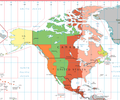
The Eastern Time Zone (ET) is a time zone encompassing part or all of 23 states in the eastern part of the United States, parts of eastern Canada, the state of Quintana Roo in Mexico, Panama in Central America, and the Caribbean Islands. Standard time in the zone is five hours behind Coordinated Universal Time (UTC−5). During daylight saving time, the Eastern Time Zone shifts to UTC−4, which is called Eastern Daylight Time (EDT).
Regions[edit]
The Eastern Time Zone includes the entire states of Connecticut, Delaware, Georgia, Maine, Maryland, Massachusetts, New Hampshire, New Jersey, New York, North Carolina, Ohio, Pennsylvania, Rhode Island, South Carolina, Vermont, Virginia, and West Virginia. Portions of Florida, Indiana, Kentucky, Michigan, and Tennessee also lie within the Eastern Time Zone.
In Canada, the province of Ontario and Quebec are primarily within the Eastern Time Zone, except for some western regions of both provinces. The Eastern Time Zone also covers the entire territory of Nunavut, with the exception of its westernmost areas.
Usage[edit]
The Eastern Time Zone is used as the basis for the North American broadcast television schedules for national networks such as CBS, NBC, ABC, and Fox. This time zone is also crucial for financial markets, as it includes the New York Stock Exchange and NASDAQ, both of which are based in New York City.
Daylight Saving Time[edit]
The Eastern Time Zone observes daylight saving time, where clocks are set forward by one hour in early March and set back in November. This practice aims to extend evening daylight in warmer months, thereby conserving energy and allowing more time for outdoor activities.
Impact on Daily Activities[edit]
The synchronization of time in the Eastern Time Zone affects various aspects of daily life, including work schedules, school hours, and the timing of public events. It also plays a significant role in the scheduling of national broadcasts and live events, which are often timed to coincide with prime viewing hours for the largest number of viewers in this time zone.
Challenges and Criticisms[edit]
The use of daylight saving time has been increasingly debated. Critics argue that the biannual shift disrupts human circadian rhythms and can lead to reduced productivity and health issues, such as heart attacks and sleep disturbances.
See also[edit]
-
 Time Zones West

