Kugel: Difference between revisions
CSV import Tags: mobile edit mobile web edit |
CSV import |
||
| Line 32: | Line 32: | ||
{{Jewish cuisine}} | {{Jewish cuisine}} | ||
{{food-stub}} | {{food-stub}} | ||
<gallery> | |||
File:Noodle_Kugel.jpg|Noodle Kugel | |||
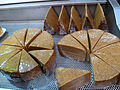
File:Kigel.JPG|Kugel | |||
File:PikiWiki_Israel_44658_Cities_in_Israel.JPG|Cities in Israel | |||
</gallery> | |||
Latest revision as of 02:10, 18 February 2025
Kugel is a traditional Jewish dish, typically served on Shabbat and Jewish holidays. The term 'kugel' is derived from the German word 'Kugel' meaning 'sphere' or 'ball', though the dish itself is usually baked in a square or rectangular pan.
History[edit]
The origins of kugel can be traced back to the 13th century in Germany, where it was a popular dish among the Jewish communities. It was traditionally cooked in a Cholent pot, which was slow-cooked over a low flame during the Sabbath, when no work could be done.
Varieties[edit]
There are two main types of kugel: potato and noodle. Potato kugel is made from grated potatoes, eggs, and onions, while noodle kugel, also known as lokshen kugel, is made from egg noodles. Both types are baked until they have a crispy top.
In addition to these, there are also sweet versions of kugel, such as apple kugel and cinnamon-raisin kugel. These are often served as a dessert or side dish.
Preparation[edit]
The preparation of kugel involves combining the ingredients in a baking dish and baking it in the oven. The dish is typically served hot, and can be served as a side dish or main course.
Cultural Significance[edit]
Kugel has a significant cultural and religious importance in Jewish tradition. It is often served during Jewish holidays, including Passover, Rosh Hashanah, and Yom Kippur. It is also a common dish at Shabbat dinners.
See Also[edit]
| Jewish cuisine | ||||||||||
|---|---|---|---|---|---|---|---|---|---|---|
* Category
|

-
Noodle Kugel
-
Kugel
-
 Cities in Israel


