Hamantash: Difference between revisions
CSV import |
CSV import |
||
| Line 1: | Line 1: | ||
{{Short description|Jewish pastry associated with the holiday of Purim}} | |||
{{ | {{Jewish cuisine}} | ||
| | |||
}} | |||
[[File:Hamantashen_NOLA_3.JPG|thumb|right|A traditional hamantash with poppy seed filling]] | |||
A '''hamantash''' (plural: '''hamantashen''') is a filled-pocket pastry recognizable for its triangular shape. It is traditionally associated with the Jewish holiday of [[Purim]], during which it is customarily eaten. The name "hamantash" is derived from "Haman," the villain in the [[Book of Esther]], and "tash," meaning "pocket" in Yiddish. | |||
== | ==History== | ||
The hamantash is believed to have originated in Europe, with its roots in the Jewish communities of Germany and Eastern Europe. The pastry's triangular shape is said to represent the hat or ears of Haman, the antagonist in the Purim story. Over time, the hamantash has become a symbol of the holiday, embodying the triumph of the Jewish people over their adversaries. | |||
== | ==Preparation== | ||
Hamantashen are made by rolling out dough, cutting it into circles, placing a dollop of filling in the center, and folding the edges to form a triangle. The dough can be made from a variety of recipes, ranging from a simple cookie dough to a yeast-based dough. Common fillings include poppy seeds, prunes, apricots, and chocolate. | |||
[[File:Hamantashen_tray_2023-03-06_2.jpg|thumb|left|A tray of hamantashen with various fillings]] | |||
== Cultural Significance == | ==Cultural Significance== | ||
During Purim, hamantashen are often exchanged as part of [[mishloach manot]], gifts of food sent to friends and family. The act of giving hamantashen is a way to fulfill the mitzvah of spreading joy and community spirit during the holiday. | |||
== | ==Variations== | ||
While the traditional hamantash is filled with poppy seeds, modern variations include a wide array of fillings such as chocolate, fruit preserves, and even savory options like cheese or spinach. The dough can also vary, with some recipes calling for a crumbly shortbread-like texture, while others use a softer, more bread-like dough. | |||
[[File:Hamantaschen.jpg|thumb|right|Hamantaschen with poppy seed filling]] | |||
==Related pages== | |||
* [[Purim]] | * [[Purim]] | ||
* [[Jewish cuisine]] | * [[Jewish cuisine]] | ||
* [[Book of Esther]] | |||
== | ==Gallery== | ||
<gallery> | |||
File:Hamantashen_NOLA_3.JPG|Hamantash | |||
File:Hamantashen_tray_2023-03-06_1.jpg|Hamantashen tray | |||
File:Hamantaschen_Purim_Dresden_(1).JPG|Hamantaschen Purim Dresden | |||
File:Flickr_-_Israel_Defense_Forces_-_IDF_Soldiers_Volunteer_for_Purim_with_Bereaved_Families_of_Fallen_Soldiers_(1).jpg|IDF Soldiers Volunteer for Purim | |||
</gallery> | |||
[[Category:Jewish cuisine]] | [[Category:Jewish cuisine]] | ||
[[Category:Purim]] | |||
[[Category:Pastries]] | [[Category:Pastries]] | ||
Latest revision as of 18:58, 23 March 2025
Jewish pastry associated with the holiday of Purim
| Jewish cuisine | ||||||||||
|---|---|---|---|---|---|---|---|---|---|---|
* Category
|

A hamantash (plural: hamantashen) is a filled-pocket pastry recognizable for its triangular shape. It is traditionally associated with the Jewish holiday of Purim, during which it is customarily eaten. The name "hamantash" is derived from "Haman," the villain in the Book of Esther, and "tash," meaning "pocket" in Yiddish.
History[edit]
The hamantash is believed to have originated in Europe, with its roots in the Jewish communities of Germany and Eastern Europe. The pastry's triangular shape is said to represent the hat or ears of Haman, the antagonist in the Purim story. Over time, the hamantash has become a symbol of the holiday, embodying the triumph of the Jewish people over their adversaries.
Preparation[edit]
Hamantashen are made by rolling out dough, cutting it into circles, placing a dollop of filling in the center, and folding the edges to form a triangle. The dough can be made from a variety of recipes, ranging from a simple cookie dough to a yeast-based dough. Common fillings include poppy seeds, prunes, apricots, and chocolate.

Cultural Significance[edit]
During Purim, hamantashen are often exchanged as part of mishloach manot, gifts of food sent to friends and family. The act of giving hamantashen is a way to fulfill the mitzvah of spreading joy and community spirit during the holiday.
Variations[edit]
While the traditional hamantash is filled with poppy seeds, modern variations include a wide array of fillings such as chocolate, fruit preserves, and even savory options like cheese or spinach. The dough can also vary, with some recipes calling for a crumbly shortbread-like texture, while others use a softer, more bread-like dough.
Related pages[edit]
Gallery[edit]
-
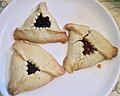 Hamantash
 -
 Hamantashen tray
 -
 Hamantaschen Purim Dresden
 -
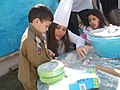 IDF Soldiers Volunteer for Purim

.JPG)
.jpg)

