Vestibulospinal tract
Vestibulospinal tract is a part of the central nervous system that contributes to the control of muscle tone, reflex, and movement. It is one of the descending spinal tracts in the brainstem and plays a crucial role in maintaining balance and posture.
Etymology[edit]
The term "vestibulospinal" is derived from the Latin words "vestibulum" which means entrance, and "spinalis" which pertains to the spine. This is because the tract originates in the vestibular nuclei located in the brainstem and descends to the spinal cord.
Anatomy[edit]
The vestibulospinal tract originates in the vestibular nuclei of the brainstem. It is divided into two tracts: the lateral vestibulospinal tract and the medial vestibulospinal tract.
Lateral Vestibulospinal Tract[edit]
The lateral vestibulospinal tract (LVST) originates in the lateral vestibular nucleus. It descends ipsilaterally in the anterior part of the spinal cord and influences neurons in the spinal cord that control extensor muscles in the trunk and limbs.
Medial Vestibulospinal Tract[edit]
The medial vestibulospinal tract (MVST) originates in the medial and inferior vestibular nuclei. It descends bilaterally in the medial longitudinal fasciculus of the spinal cord and influences neurons that control neck muscles.
Function[edit]
The vestibulospinal tract is responsible for maintaining balance and posture. It does this by adjusting muscle tone, extending the limbs, and positioning the head in response to changes in body position. It also plays a role in the vestibulo-ocular reflex, which allows the eyes to remain focused on an object while the head is moving.
Clinical Significance[edit]
Damage to the vestibulospinal tract can result in a variety of symptoms, including vertigo, nystagmus, and ataxia. These symptoms are often associated with conditions such as Meniere's disease, vestibular neuritis, and labyrinthitis.
See Also[edit]
References[edit]

This WikiMD article can only be edited by registered and verified editors. You can log in or register.
-
 Diagram of spinal cord tracts
 -
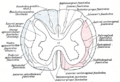 Cross-section of the spinal cord
 -
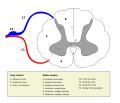 Section of the medulla spinalis


Advertise on WikiMD — 81,000+ full articles, ~900,000 total pages, ~250 million page views. Global reach, limited time promotional rates from $1/page/day. Learn more · View stats


Translate page: - East Asian
中文,
日本,
한국어,
South Asian
हिन्दी,
தமிழ்,
తెలుగు,
Urdu,
ಕನ್ನಡ,
Southeast Asian
Indonesian,
Vietnamese,
Thai,
မြန်မာဘာသာ,
বাংলা
European
español,
Deutsch,
français,
Greek,
português do Brasil,
polski,
română,
русский,
Nederlands,
norsk,
svenska,
suomi,
Italian
Middle Eastern & African
عربى,
Turkish,
Persian,
Hebrew,
Afrikaans,
isiZulu,
Kiswahili,
Other
Bulgarian,
Hungarian,
Czech,
Swedish,
മലയാളം,
मराठी,
ਪੰਜਾਬੀ,
ગુજરાતી,
Portuguese,
Ukrainian
About WikiMD • Contact • Disclaimer • Privacy • Copyright • Site statistics
Some content and images may originate from Wikimedia Commons or Wikipedia and remain subject to their stated licenses. Unless otherwise noted, eligible WikiMD content is available under CC BY-SA 4.0.
WikiMD Wellnesspedia — Free health & wellness information for patients, students, and health professionals.

