Phenylacetic acid
Phenylacetic acid (PAA), also known as alpha-toluic acid, is an organic compound with the formula C6H5CH2COOH. It is a white, solid substance with a characteristic honey-like odor. Phenylacetic acid is classified as an aromatic carboxylic acid and is used in various chemical syntheses, including the production of pharmaceuticals, perfumes, and polymers.
Properties[edit]
Phenylacetic acid is slightly soluble in water but highly soluble in organic solvents such as ethanol, diethyl ether, and benzene. It has a melting point of 76.5-77.5 °C and a boiling point of 265.5 °C. The compound exhibits a strong absorption in the ultraviolet-visible spectrum, which is characteristic of aromatic compounds.
Synthesis[edit]
Phenylacetic acid can be synthesized through several methods. One common approach is the oxidation of ethylbenzene or benzyl chloride. Another method involves the hydrolysis of benzyl cyanide, which is a nitrile hydrolysis reaction.
Applications[edit]
Pharmaceuticals[edit]
Phenylacetic acid is a precursor in the synthesis of a variety of pharmaceuticals. It is used in the production of penicillin G, a widely used antibiotic, and phenylacetone, which is an intermediate in the synthesis of amphetamines. Its derivatives, such as phenylacetylglutamine, are excreted by humans after ingestion of phenylalanine, making it relevant in medical research and diagnostics.
Perfumery[edit]
In the perfumery industry, phenylacetic acid is valued for its honey-like odor. It is used as a fixative or an additive in the formulation of fragrances and flavorings.
Chemical Synthesis[edit]
Beyond its applications in pharmaceuticals and perfumery, phenylacetic acid serves as a starting material in the synthesis of various organic compounds. It is involved in the production of dyes, synthetic resins, and other polymers.
Safety and Regulation[edit]
Phenylacetic acid must be handled with care due to its potential health hazards. It can cause skin irritation and severe eye damage upon contact. Inhalation of its vapors can lead to respiratory irritation. Safety measures, including the use of personal protective equipment, are recommended when handling this chemical.
In some jurisdictions, phenylacetic acid is regulated due to its use as a precursor in the illicit synthesis of phenylacetone, which can be further processed into amphetamines. Regulations may include monitoring of its sale, distribution, and use.
See Also[edit]

Phenylacetic_acid[edit]
-
 Structural formula of phenylacetic acid
 -
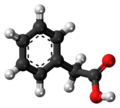 Ball-and-stick model of phenylacetic acid
 -
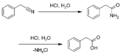 Synthesis of phenylacetic acid from benzyl cyanide
 -
 Phenylacetic acid


Sponsored Health Resource

W8MD Weight Loss, Sleep & MedSpa
Looking for physician-supervised weight loss, semaglutide, tirzepatide, or GLP-1 receptor agonist options? W8MD helps eligible patients in New York City, Brooklyn, New Jersey, Connecticut, Pennsylvania, Delaware, and greater Philadelphia with medical weight loss, sleep medicine, and long-term maintenance support.
GLP-1 specials: Affordable GLP-1 injections NYC and Philadelphia starting from $29.99/week and up for semaglutide with insurance accepted for qualifying visits, and $45/week and up for tirzepatide with insurance accepted for qualifying visits. Self-pay options start from $59.99/week and up for semaglutide and $69.99/week and up for tirzepatide.
Medical weight loss NYC | Affordable GLP-1 injections NYC | Budget GLP-1 weight loss shots Philadelphia | New Jersey medical weight loss | NYC medical weight loss | Philadelphia medical weight loss | Sleep clinic NYC | W8MD's Philadelphia GLP-1 doctor | Weight loss prescriptions NYC
Book a W8MD appointment · View GLP-1 specials
Paid promotional message. Eligibility, pricing, insurance coverage, medication availability, and results vary. Medical evaluation required.

Medical Disclaimer: WikiMD is for informational purposes only and is not a substitute for professional medical advice. Content may be inaccurate or outdated and should not be used for diagnosis or treatment. Always consult your healthcare provider for medical decisions. Verify information with trusted sources such as CDC.gov and NIH.gov. By using this site, you agree that WikiMD is not liable for any outcomes related to its content. See full disclaimer.
Credits:Most images are courtesy of Wikimedia commons, and templates, categories Wikipedia, licensed under CC BY SA or similar.
Translate page: - East Asian
中文,
日本,
한국어,
South Asian
हिन्दी,
தமிழ்,
తెలుగు,
Urdu,
ಕನ್ನಡ,
Southeast Asian
Indonesian,
Vietnamese,
Thai,
မြန်မာဘာသာ,
বাংলা
European
español,
Deutsch,
français,
Greek,
português do Brasil,
polski,
română,
русский,
Nederlands,
norsk,
svenska,
suomi,
Italian
Middle Eastern & African
عربى,
Turkish,
Persian,
Hebrew,
Afrikaans,
isiZulu,
Kiswahili,
Other
Bulgarian,
Hungarian,
Czech,
Swedish,
മലയാളം,
मराठी,
ਪੰਜਾਬੀ,
ગુજરાતી,
Portuguese,
Ukrainian

