Slipper lobster
The Slipper Lobster (Scyllaridae) is a family of decapod crustaceans known for their flattened bodies and robust, clawless chelipeds. They are found in all warm oceans and seas of the world, including the Atlantic, Pacific, and Indian Oceans.
Description[edit]
Slipper lobsters are instantly recognizable by their enlarged antennae, which appear as flattened plates that extend in front of the body. Unlike other lobsters, they do not have large claws; instead, they have small, hook-like appendages. Their bodies are usually cream or brown in color, with some species exhibiting spots or patterns.
Behavior and Diet[edit]
Slipper lobsters are nocturnal, hiding during the day and emerging at night to feed. They are omnivorous, feeding on a variety of organisms including mollusks, echinoderms, and cnidarians. Some species are also known to scavenge.
Commercial Importance[edit]
Several species of slipper lobsters are commercially important and are caught for food. They are considered a delicacy in many parts of the world, including Australia, Japan, and the Mediterranean. However, overfishing has led to a decline in some populations, leading to calls for better management and conservation efforts.
Taxonomy[edit]
The family Scyllaridae is divided into several subfamilies and includes around 90 species. The two most well-known genera are Scyllarus and Thenus, the latter of which includes the commercially important Moreton Bay Bug.
See Also[edit]
.png) | This crustacean-related article is a stub. You can help WikiMD by expanding the page. |

-
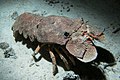 Scyllarides latus
 -
 Scyllaridae larvae
 -
 Scyllarus FIGIS 1957 2007
 -
 Pariibacus japonicus
 -
 Scyllarus arctus
 -
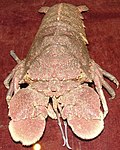 Arctides antipodum
 -
 Ibacus ciliatus
 -
 Parribacus antarcticus


Medical Disclaimer: WikiMD is for informational purposes only and is not a substitute for professional medical advice. Content may be inaccurate or outdated and should not be used for diagnosis or treatment. Always consult your healthcare provider for medical decisions. Verify information with trusted sources such as CDC.gov and NIH.gov. By using this site, you agree that WikiMD is not liable for any outcomes related to its content. See full disclaimer.
Credits:Most images are courtesy of Wikimedia commons, and templates, categories Wikipedia, licensed under CC BY SA or similar.
Translate page: - East Asian
中文,
日本,
한국어,
South Asian
हिन्दी,
தமிழ்,
తెలుగు,
Urdu,
ಕನ್ನಡ,
Southeast Asian
Indonesian,
Vietnamese,
Thai,
မြန်မာဘာသာ,
বাংলা
European
español,
Deutsch,
français,
Greek,
português do Brasil,
polski,
română,
русский,
Nederlands,
norsk,
svenska,
suomi,
Italian
Middle Eastern & African
عربى,
Turkish,
Persian,
Hebrew,
Afrikaans,
isiZulu,
Kiswahili,
Other
Bulgarian,
Hungarian,
Czech,
Swedish,
മലയാളം,
मराठी,
ਪੰਜਾਬੀ,
ગુજરાતી,
Portuguese,
Ukrainian

