Shami kebab
Shami Kebab is a popular kebab variety originating from the Indian subcontinent. It is part of the cuisine of countries like India, Pakistan, and Bangladesh. The dish is named after Syria's capital, Damascus, which is also known as Shām in Arabic.
History[edit]
The Shami Kebab was introduced to the Indian subcontinent during the Mughal Empire by Muslim cooks from the Middle East. It was particularly popular in the royal courts of the Mughal emperors.
Preparation[edit]
Shami Kebabs are made from a mixture of minced meat, usually beef, mutton, or chicken, and chana dal (split chickpeas). The meat and dal are boiled together with various spices until they are fully cooked and the water has evaporated. The mixture is then ground into a paste, shaped into patties, and fried.
Variations[edit]
There are many regional variations of Shami Kebab. In Hyderabad, India, they are often filled with a boiled egg or spiced minced meat. In Bangladesh, they are usually made with beef and are smaller in size.
Serving[edit]
Shami Kebabs are typically served with mint chutney or yogurt and are often included in the Iftar meal during Ramadan.
See also[edit]

Shami_kebab[edit]
-
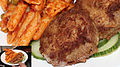 4th October 2012 Shami Kebab
 -
Shami Kebab


Medical Disclaimer: WikiMD is for informational purposes only and is not a substitute for professional medical advice. Content may be inaccurate or outdated and should not be used for diagnosis or treatment. Always consult your healthcare provider for medical decisions. Verify information with trusted sources such as CDC.gov and NIH.gov. By using this site, you agree that WikiMD is not liable for any outcomes related to its content. See full disclaimer.
Credits:Most images are courtesy of Wikimedia commons, and templates, categories Wikipedia, licensed under CC BY SA or similar.
Translate page: - East Asian
中文,
日本,
한국어,
South Asian
हिन्दी,
தமிழ்,
తెలుగు,
Urdu,
ಕನ್ನಡ,
Southeast Asian
Indonesian,
Vietnamese,
Thai,
မြန်မာဘာသာ,
বাংলা
European
español,
Deutsch,
français,
Greek,
português do Brasil,
polski,
română,
русский,
Nederlands,
norsk,
svenska,
suomi,
Italian
Middle Eastern & African
عربى,
Turkish,
Persian,
Hebrew,
Afrikaans,
isiZulu,
Kiswahili,
Other
Bulgarian,
Hungarian,
Czech,
Swedish,
മലയാളം,
मराठी,
ਪੰਜਾਬੀ,
ગુજરાતી,
Portuguese,
Ukrainian


