Rice milk
Rice milk is a type of plant milk made from rice. It is mostly made from brown rice and commonly unsweetened, but it can also be made from white rice. The process of making rice milk involves milling the rice and mixing it with water, followed by filtration to remove insoluble residues.
Composition and Nutrition[edit]
Rice milk is naturally free of cholesterol and lactose, making it a good alternative for those who are lactose intolerant or have a milk allergy. It is also suitable for vegan diets. However, it is not a good source of protein and contains more carbohydrates than cow's milk. Some commercial brands of rice milk are fortified with vitamins and minerals, such as vitamin B12, calcium, and iron.
Uses[edit]
Rice milk is often used as a substitute for cow's milk in many recipes, including baking and cooking. It can also be used in cereal, coffee, and tea. Its naturally sweet taste makes it a popular choice for desserts and smoothies.
Health Concerns[edit]
While rice milk is a good alternative for those with lactose intolerance or milk allergies, it is not recommended for infants and young children due to its low protein content. There are also concerns about the levels of arsenic in rice milk, as rice is known to absorb more arsenic from the environment than other grains.
See Also[edit]

-
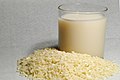 Rice milk
 -
 Amazake by Emily Harbour in July
 -
 Amazake


.jpg)

Medical Disclaimer: WikiMD is for informational purposes only and is not a substitute for professional medical advice. Content may be inaccurate or outdated and should not be used for diagnosis or treatment. Always consult your healthcare provider for medical decisions. Verify information with trusted sources such as CDC.gov and NIH.gov. By using this site, you agree that WikiMD is not liable for any outcomes related to its content. See full disclaimer.
Credits:Most images are courtesy of Wikimedia commons, and templates, categories Wikipedia, licensed under CC BY SA or similar.
Translate page: - East Asian
中文,
日本,
한국어,
South Asian
हिन्दी,
தமிழ்,
తెలుగు,
Urdu,
ಕನ್ನಡ,
Southeast Asian
Indonesian,
Vietnamese,
Thai,
မြန်မာဘာသာ,
বাংলা
European
español,
Deutsch,
français,
Greek,
português do Brasil,
polski,
română,
русский,
Nederlands,
norsk,
svenska,
suomi,
Italian
Middle Eastern & African
عربى,
Turkish,
Persian,
Hebrew,
Afrikaans,
isiZulu,
Kiswahili,
Other
Bulgarian,
Hungarian,
Czech,
Swedish,
മലയാളം,
मराठी,
ਪੰਜਾਬੀ,
ગુજરાતી,
Portuguese,
Ukrainian

