Pleistocene
The Pleistocene is a geological epoch from the Cenozoic Era, which lasted from about 2.6 million to 11,700 years ago, spanning the world's most recent period of repeated glaciations. The end of the Pleistocene corresponds with the end of the last Ice Age and also with the end of the Paleolithic age used in archaeology.
Etymology and definition[edit]
The name Pleistocene is derived from the Greek pleistos (most) and kainos (new). The Pleistocene has been dated from 2.588 million (±0.005) to 11,700 years before present (BP), with the end date expressed in radiocarbon years as 10,000 carbon-14 years BP. It covers most of the latest period of repeated glaciation, up to and including the Younger Dryas cold spell.
Climate and geography[edit]
The Pleistocene climate was marked by repeated glacial cycles where continental glaciers pushed to the 40th parallel in some places. It is estimated that, at maximum glacial extent, 30% of the Earth's surface was covered by ice. In addition, a zone of permafrost stretched southward from the edge of the glacial sheet, a few hundred kilometers in North America, and several hundred in Eurasia. The mean annual temperature at the edge of the ice was −6 °C (21 °F); at the edge of the permafrost, 0 °C (32 °F).
Flora and fauna[edit]
The Pleistocene was characterized by the presence of large land mammals, including mammoths, mastodons, saber-toothed cats, giant ground sloths, and others. The megafauna extinction occurred between the end of the Pleistocene and the early Holocene.
Human evolution[edit]
The Pleistocene is the first epoch to witness the evolution and expansion of Homo sapiens. Archaeological and genetic data suggest that the source populations of Paleolithic humans survived in sparsely wooded areas and dispersed through areas of high primary productivity while avoiding dense forest cover.
See also[edit]
References[edit]

This WikiMD article can only be edited by registered and verified editors. You can log in or register.
-
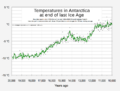 Temperature from 20,000 to 10,000 years ago - recovery from ice age


Medical Disclaimer: WikiMD is for informational purposes only and is not a substitute for professional medical advice. Content may be inaccurate or outdated and should not be used for diagnosis or treatment. Always consult your healthcare provider for medical decisions. Verify information with trusted sources such as CDC.gov and NIH.gov. By using this site, you agree that WikiMD is not liable for any outcomes related to its content. See full disclaimer.
Credits:Most images are courtesy of Wikimedia commons, and templates, categories Wikipedia, licensed under CC BY SA or similar.
Translate page: - East Asian
中文,
日本,
한국어,
South Asian
हिन्दी,
தமிழ்,
తెలుగు,
Urdu,
ಕನ್ನಡ,
Southeast Asian
Indonesian,
Vietnamese,
Thai,
မြန်မာဘာသာ,
বাংলা
European
español,
Deutsch,
français,
Greek,
português do Brasil,
polski,
română,
русский,
Nederlands,
norsk,
svenska,
suomi,
Italian
Middle Eastern & African
عربى,
Turkish,
Persian,
Hebrew,
Afrikaans,
isiZulu,
Kiswahili,
Other
Bulgarian,
Hungarian,
Czech,
Swedish,
മലയാളം,
मराठी,
ਪੰਜਾਬੀ,
ગુજરાતી,
Portuguese,
Ukrainian

