Mughlai paratha
Mughlai Paratha is a popular Indian and Bangladeshi dish, originating from the Mughal era. It is a rich, flaky, stuffed bread that is often enjoyed with a side of curry or raita.
History[edit]
The Mughlai Paratha was introduced during the Mughal period in India, hence the name 'Mughlai' which refers to the cooking styles of the Mughal Empire. The dish has since become a staple in many parts of India and Bangladesh, particularly in the regions of West Bengal, Kolkata, and Dhaka.
Preparation[edit]
The preparation of Mughlai Paratha involves making a dough from wheat flour, which is then rolled out into a circle or square. The dough is filled with a mixture of ingredients, typically including egg, onion, green chili, and minced meat (such as chicken, mutton, or beef). The filled dough is then folded over to seal the filling inside, creating a parcel shape. This is then shallow-fried in ghee or oil until golden brown.
Variations[edit]
There are many variations of Mughlai Paratha, with different fillings used depending on the region and personal preference. Some versions may include cheese, paneer, or vegetables in the filling. In some parts of Bangladesh, a sweet version of the dish is made with coconut and sugar.
Serving[edit]
Mughlai Paratha is typically served hot, often with a side of curry or raita. It can be eaten as a main meal, or as a snack. In some regions, it is also a popular street food.
See also[edit]

This Bangladesh-food related article is a stub. You can help WikiMD by expanding it.

-
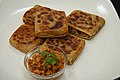 Mughlai Kheema Paratha

Mughlai_paratha[edit]

Medical Disclaimer: WikiMD is for informational purposes only and is not a substitute for professional medical advice. Content may be inaccurate or outdated and should not be used for diagnosis or treatment. Always consult your healthcare provider for medical decisions. Verify information with trusted sources such as CDC.gov and NIH.gov. By using this site, you agree that WikiMD is not liable for any outcomes related to its content. See full disclaimer.
Credits:Most images are courtesy of Wikimedia commons, and templates, categories Wikipedia, licensed under CC BY SA or similar.
Translate page: - East Asian
中文,
日本,
한국어,
South Asian
हिन्दी,
தமிழ்,
తెలుగు,
Urdu,
ಕನ್ನಡ,
Southeast Asian
Indonesian,
Vietnamese,
Thai,
မြန်မာဘာသာ,
বাংলা
European
español,
Deutsch,
français,
Greek,
português do Brasil,
polski,
română,
русский,
Nederlands,
norsk,
svenska,
suomi,
Italian
Middle Eastern & African
عربى,
Turkish,
Persian,
Hebrew,
Afrikaans,
isiZulu,
Kiswahili,
Other
Bulgarian,
Hungarian,
Czech,
Swedish,
മലയാളം,
मराठी,
ਪੰਜਾਬੀ,
ગુજરાતી,
Portuguese,
Ukrainian

