Japanese curry
Japanese Curry is a popular dish in Japan that has been adapted from traditional Indian curry. It is typically thicker, sweeter, and less spicy than its Indian counterpart, making it a unique fusion of flavors that is distinctly Japanese.
History[edit]
Japanese curry, or Curry Rice (Karē Raisu), was introduced to Japan during the Meiji era (1868–1912) by the British, who were then India's colonial rulers. The dish was initially served in Japan's navy and army to prevent beriberi, a disease caused by vitamin B1 deficiency. Over time, it became a staple in Japanese households and is now considered a national dish.
Ingredients and Preparation[edit]
The main ingredients of Japanese curry are meat, potatoes, carrots, and onions. The meat used can be chicken, pork, or beef. The curry roux, a mixture of wheat flour and fat, is the key ingredient that gives the dish its characteristic flavor and thickness. The roux is typically bought ready-made in blocks that are dissolved in water and added to the stewed ingredients.
Japanese curry is often served with rice and pickled vegetables called Fukujinzuke. It can also be used as a filling for bread, a topping for noodles, or a sauce for katsu (breaded and fried meat cutlets).
Variations[edit]
There are several regional variations of Japanese curry. In Hokkaido, the curry is often served with a slice of butter on top, while in Okinawa, it is common to use Goya (bitter melon) and Spam in the curry. Some restaurants in Japan also offer vegetarian or vegan versions of the dish.
Cultural Significance[edit]
Japanese curry is not only a beloved comfort food in Japan but also a symbol of the country's adaptation and reinterpretation of foreign dishes. It is commonly served in school cafeterias, making it a nostalgic dish for many Japanese people. Moreover, it is often the first dish that Japanese children learn to cook.
See Also[edit]
|
This article is part of the series |
|
Japanese cuisine |
|---|
|
Regional cuisines |
|
Ingredients |
|
Preparation and cooking |
|
Utensils |
|
Rituals and festivals |
|
|
| Curry | ||||||||||
|---|---|---|---|---|---|---|---|---|---|---|
|

-
 Japanese curry
 -
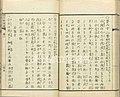 First curry rice recipe of Japan, 1872
 -
 Curry udon
 -
 Bon curry
 -
 Curry pan
 -
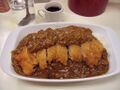 Katsu curry
 -
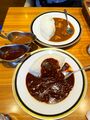 Hayashi rice and curry rice in Tokyo
 -
 Japanese curry rice with shredded beef
 -
 Japanese Navy curry cookbook, 1908


Sponsored Health Resource

W8MD Weight Loss, Sleep & MedSpa
Looking for physician-supervised weight loss, semaglutide, tirzepatide, or GLP-1 receptor agonist options? W8MD helps eligible patients in New York City, Brooklyn, New Jersey, Connecticut, Pennsylvania, Delaware, and greater Philadelphia with medical weight loss, sleep medicine, and long-term maintenance support.
GLP-1 specials: Affordable GLP-1 injections NYC and Philadelphia starting from $29.99/week and up for semaglutide with insurance accepted for qualifying visits, and $45/week and up for tirzepatide with insurance accepted for qualifying visits. Self-pay options start from $59.99/week and up for semaglutide and $69.99/week and up for tirzepatide.
Medical weight loss NYC | Affordable GLP-1 injections NYC | Budget GLP-1 weight loss shots Philadelphia | New Jersey medical weight loss | NYC medical weight loss | Philadelphia medical weight loss | Sleep clinic NYC | W8MD's Philadelphia GLP-1 doctor | Weight loss prescriptions NYC
Book a W8MD appointment · View GLP-1 specials
Paid promotional message. Eligibility, pricing, insurance coverage, medication availability, and results vary. Medical evaluation required.

Medical Disclaimer: WikiMD is for informational purposes only and is not a substitute for professional medical advice. Content may be inaccurate or outdated and should not be used for diagnosis or treatment. Always consult your healthcare provider for medical decisions. Verify information with trusted sources such as CDC.gov and NIH.gov. By using this site, you agree that WikiMD is not liable for any outcomes related to its content. See full disclaimer.
Credits:Most images are courtesy of Wikimedia commons, and templates, categories Wikipedia, licensed under CC BY SA or similar.
Translate page: - East Asian
中文,
日本,
한국어,
South Asian
हिन्दी,
தமிழ்,
తెలుగు,
Urdu,
ಕನ್ನಡ,
Southeast Asian
Indonesian,
Vietnamese,
Thai,
မြန်မာဘာသာ,
বাংলা
European
español,
Deutsch,
français,
Greek,
português do Brasil,
polski,
română,
русский,
Nederlands,
norsk,
svenska,
suomi,
Italian
Middle Eastern & African
عربى,
Turkish,
Persian,
Hebrew,
Afrikaans,
isiZulu,
Kiswahili,
Other
Bulgarian,
Hungarian,
Czech,
Swedish,
മലയാളം,
मराठी,
ਪੰਜਾਬੀ,
ગુજરાતી,
Portuguese,
Ukrainian

