Japanese New Year
Japanese New Year (Oshogatsu) is one of the most important annual events in Japan. It is celebrated on January 1st, the first day of the Gregorian calendar. The celebration of the Japanese New Year is a blend of Shinto, Buddhist, and secular customs that have evolved over centuries.
History[edit]
The Japanese New Year has been celebrated since the Heian period, but it was during the Meiji era that January 1st became the official New Year's Day. Prior to this, the New Year was celebrated according to the Chinese lunar calendar.
Customs and Traditions[edit]
The Japanese New Year is a time for various customs and traditions. These include the first visit to a shrine or temple (Hatsumode), the first sunrise of the year (Hatsuhinode), and the preparation and consumption of special New Year's foods known as Osechi.
Hatsumode[edit]
Hatsumode is the first shrine or temple visit of the New Year. Many people visit a Shinto shrine during the New Year's period (January 1-3). During this visit, prayers are offered for the coming year's health, happiness, and prosperity.
Hatsuhinode[edit]
Hatsuhinode is the first sunrise of the New Year. Many Japanese people wake up early on New Year's Day to watch the first sunrise of the year, believing it to bring good luck for the coming year.
Osechi[edit]
Osechi are traditional Japanese New Year foods. The dishes that make up osechi each have a special meaning celebrating the New Year. Some of these dishes include Kazunoko (herring roe, symbolizing fertility), Kuromame (black soybeans, symbolizing health), and Tazukuri (candied sardines, symbolizing a bountiful harvest).
See Also[edit]
 | This Japan-related article is a stub. You can help WikiMD by expanding the page. |
 | This holiday-related article is a stub. You can help WikiMD by expanding the page. |
-
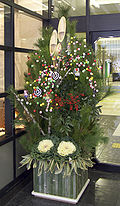 Kadomatsu decoration for Japanese New Year
 -
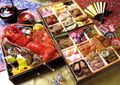 Traditional Osechi-ryori for New Year
 -
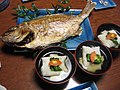 Zoni soup and roasted fish for New Year
 -
 Kagamimochi for New Year
 -
 Joyanokane bell ringing ceremony
 -
 Japanese New Year card
 -
 Otoshidama Poti Bag Origami
 -
 Takarabune by Hiroshige
 -
 Large kite for New Year


Medical Disclaimer: WikiMD is for informational purposes only and is not a substitute for professional medical advice. Content may be inaccurate or outdated and should not be used for diagnosis or treatment. Always consult your healthcare provider for medical decisions. Verify information with trusted sources such as CDC.gov and NIH.gov. By using this site, you agree that WikiMD is not liable for any outcomes related to its content. See full disclaimer.
Credits:Most images are courtesy of Wikimedia commons, and templates, categories Wikipedia, licensed under CC BY SA or similar.
Translate page: - East Asian
中文,
日本,
한국어,
South Asian
हिन्दी,
தமிழ்,
తెలుగు,
Urdu,
ಕನ್ನಡ,
Southeast Asian
Indonesian,
Vietnamese,
Thai,
မြန်မာဘာသာ,
বাংলা
European
español,
Deutsch,
français,
Greek,
português do Brasil,
polski,
română,
русский,
Nederlands,
norsk,
svenska,
suomi,
Italian
Middle Eastern & African
عربى,
Turkish,
Persian,
Hebrew,
Afrikaans,
isiZulu,
Kiswahili,
Other
Bulgarian,
Hungarian,
Czech,
Swedish,
മലയാളം,
मराठी,
ਪੰਜਾਬੀ,
ગુજરાતી,
Portuguese,
Ukrainian

