Fischbrötchen
| File:Fischbroetchen.JPG | |
| Fischbrötchen with pickled herring | |
| Alternative names | Fischsemmel |
| Type | Sandwich |
| Course | |
| Place of origin | Germany |
| Region or state | |
| Associated national cuisine | |
| Created by | |
| Invented | |
| Cooking time | minutes to minutes |
| Serving temperature | |
| Main ingredients | Bread, fish, onions; sometimes remoulade and pickles |
| Ingredients generally used | |
| Variations | |
| Food energy | kcal |
| Nutritional value | Protein: g, Fat: g, Carbohydrate: g |
| Glycemic index | |
| Similar dishes | |
| Other information | |
| Website | [ Official website] |
A Fischbrötchen (plural: Fischbrötchen) or Fischsemmel is a signature sandwich hailing from the Northern regions of Germany. Literally translating to "fish bun", this sandwich represents a harmonious blend of freshly caught fish, aromatic onions, and often accompanied by remoulade and pickles. Due to Northern Germany's strategic position by the North Sea and Baltic Sea, seafood, especially fish, forms an intrinsic part of the regional diet, making Fischbrötchen a popular culinary delight.
Ingredients and Varieties[edit]
While the primary ingredient is fish, the exact type can vary, leading to a plethora of Fischbrötchen varieties:
- Bismarck herring: One of the most traditional preparations, it uses herring marinated in a vinegar solution.
- Soused herring: Another common herring preparation.
- Brathering: This refers to fried, marinated herring.
- Rollmops: A pickled herring fillet rolled into a cylindrical shape.
- European sprat: Small fish, often smoked or fried.
- Salmon: Especially smoked salmon gives the sandwich a rich and distinctive taste.
- Smoked Atlantic mackerel: Adds a smoky flavor to the sandwich.
- Fish burgers: Fried fish varieties in the form of patties.
- Prawns: Occasionally used for a change in texture and flavor.
Various other food fish species are also used to diversify the Fischbrötchen range.
Serving and Consumption[edit]
While traditionally a staple among local households, the Fischbrötchen has made its way to commercial avenues. Many fast food joints, kiosks, and take-out restaurants in Northern Germany have this iconic sandwich on their menu, making it an easily accessible treat for both locals and tourists.
Historical Tidbit: Hanover Fair[edit]
Interestingly, the renowned Hanover fair, initially in its 1947 inception, was dubbed the "Fischbrötchen fair". This nickname arose from the post-war food rationing still in place at the time, emphasizing the significant role of this humble sandwich in German culinary history.
-
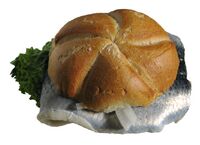 Fischbrötchen
 -
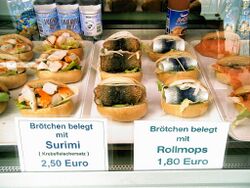 A variety of Fischbrötchen, including with Rollmops


See Also[edit]
References[edit]


Medical Disclaimer: WikiMD is for informational purposes only and is not a substitute for professional medical advice. Content may be inaccurate or outdated and should not be used for diagnosis or treatment. Always consult your healthcare provider for medical decisions. Verify information with trusted sources such as CDC.gov and NIH.gov. By using this site, you agree that WikiMD is not liable for any outcomes related to its content. See full disclaimer.
Credits:Most images are courtesy of Wikimedia commons, and templates, categories Wikipedia, licensed under CC BY SA or similar.
Translate page: - East Asian
中文,
日本,
한국어,
South Asian
हिन्दी,
தமிழ்,
తెలుగు,
Urdu,
ಕನ್ನಡ,
Southeast Asian
Indonesian,
Vietnamese,
Thai,
မြန်မာဘာသာ,
বাংলা
European
español,
Deutsch,
français,
Greek,
português do Brasil,
polski,
română,
русский,
Nederlands,
norsk,
svenska,
suomi,
Italian
Middle Eastern & African
عربى,
Turkish,
Persian,
Hebrew,
Afrikaans,
isiZulu,
Kiswahili,
Other
Bulgarian,
Hungarian,
Czech,
Swedish,
മലയാളം,
मराठी,
ਪੰਜਾਬੀ,
ગુજરાતી,
Portuguese,
Ukrainian


