Eicosanoid
Eicosanoids are a group of lipid compounds derived from fatty acids, specifically twenty-carbon essential fatty acids. They play a crucial role in biochemistry and physiology, particularly in inflammation and immunity.
Overview[edit]
Eicosanoids are derived from the fatty acid arachidonic acid. They are a diverse group of compounds, including prostaglandins, thromboxanes, and leukotrienes. These compounds are involved in a wide range of physiological processes, including inflammation, immunity, platelet aggregation, and vasoconstriction.
Biosynthesis[edit]
The biosynthesis of eicosanoids begins with the release of arachidonic acid from the phospholipid membrane by the enzyme phospholipase A2. This is followed by the conversion of arachidonic acid into various eicosanoids through different enzymatic pathways, including the cyclooxygenase (COX) pathway and the lipoxygenase (LOX) pathway.
Functions[edit]
Eicosanoids have a wide range of functions in the body. They are involved in the regulation of inflammation and immune responses, the control of blood pressure, and the regulation of blood clotting. They also play a role in the regulation of cell growth and differentiation, and in the control of pain and fever.
Clinical significance[edit]
Due to their role in inflammation and immunity, eicosanoids are implicated in a number of diseases, including asthma, arthritis, cancer, and cardiovascular disease. Drugs that target the biosynthesis or action of eicosanoids, such as non-steroidal anti-inflammatory drugs (NSAIDs) and corticosteroids, are widely used in the treatment of these diseases.
See also[edit]
- Arachidonic acid
- Prostaglandins
- Thromboxanes
- Leukotrienes
- Phospholipase A2
- Cyclooxygenase
- Lipoxygenase
- Non-steroidal anti-inflammatory drugs
- Corticosteroids

This WikiMD article can only be edited by registered and verified editors. You can log in or register.
-
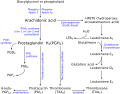 Eicosanoid synthesis pathway
 -
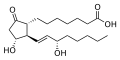 Structure of Prostaglandin E1
 -
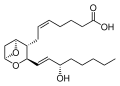 Structure of Thromboxane A2
 -
Structure of Leukotriene B4
-
Structure of Prostaglandin I2
-
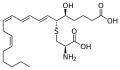 Structure of Leukotriene E4
 -
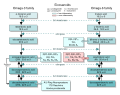 Conversion of Essential Fatty Acids to Eicosanoids


Medical Disclaimer: WikiMD is for informational purposes only and is not a substitute for professional medical advice. Content may be inaccurate or outdated and should not be used for diagnosis or treatment. Always consult your healthcare provider for medical decisions. Verify information with trusted sources such as CDC.gov and NIH.gov. By using this site, you agree that WikiMD is not liable for any outcomes related to its content. See full disclaimer.
Credits:Most images are courtesy of Wikimedia commons, and templates, categories Wikipedia, licensed under CC BY SA or similar.
Translate page: - East Asian
中文,
日本,
한국어,
South Asian
हिन्दी,
தமிழ்,
తెలుగు,
Urdu,
ಕನ್ನಡ,
Southeast Asian
Indonesian,
Vietnamese,
Thai,
မြန်မာဘာသာ,
বাংলা
European
español,
Deutsch,
français,
Greek,
português do Brasil,
polski,
română,
русский,
Nederlands,
norsk,
svenska,
suomi,
Italian
Middle Eastern & African
عربى,
Turkish,
Persian,
Hebrew,
Afrikaans,
isiZulu,
Kiswahili,
Other
Bulgarian,
Hungarian,
Czech,
Swedish,
മലയാളം,
मराठी,
ਪੰਜਾਬੀ,
ગુજરાતી,
Portuguese,
Ukrainian


