Dinoseb
Dinoseb is an organic compound that is commonly used as a herbicide. It is a yellow, crystalline solid that is soluble in water and most organic solvents. Dinoseb is known for its high toxicity and potential for causing harm to both humans and the environment.
Chemical Properties[edit]
Dinoseb is a phenol derivative, specifically a dinitrophenol, and its chemical formula is C6H4N2O5. It has a molecular weight of 225.11 g/mol. The compound is highly reactive and can undergo various chemical reactions, including oxidation and reduction.
Uses[edit]
Historically, dinoseb was widely used as a herbicide and pesticide. It was effective in controlling a wide range of weeds and pests in various crops, including soybeans, corn, and cotton. However, due to its high toxicity and potential for environmental harm, its use has been severely restricted in many countries.
Health Effects[edit]
Exposure to dinoseb can cause a variety of health effects. Acute exposure can lead to symptoms such as nausea, vomiting, headache, and dizziness. Chronic exposure can lead to more serious health problems, including liver damage, kidney damage, and cancer. Dinoseb is also known to be a potential endocrine disruptor.
Environmental Impact[edit]
Dinoseb is highly toxic to aquatic life and can cause long-term damage to aquatic ecosystems. It is also persistent in the environment and can accumulate in the food chain, posing a risk to wildlife and humans.
Regulation[edit]
Due to its high toxicity and environmental impact, the use of dinoseb has been banned or restricted in many countries. In the United States, the Environmental Protection Agency (EPA) banned the use of dinoseb in 1986.
See Also[edit]

 | This medical article is a stub. You can help WikiMD by expanding the page. |
-
Dinoseb metabolism
-
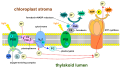 Thylakoid membrane
 -
Synthesis 1
-
Synthesis 2
-
Synthesis of dinoseb step 3
-
Synthesis 4
-
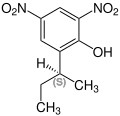 (S)-Dinoseb
 -
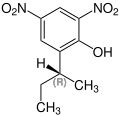 (R)-Dinoseb

-Dinoseb_V1.svg)
-Dinoseb_V1.svg)

Medical Disclaimer: WikiMD is for informational purposes only and is not a substitute for professional medical advice. Content may be inaccurate or outdated and should not be used for diagnosis or treatment. Always consult your healthcare provider for medical decisions. Verify information with trusted sources such as CDC.gov and NIH.gov. By using this site, you agree that WikiMD is not liable for any outcomes related to its content. See full disclaimer.
Credits:Most images are courtesy of Wikimedia commons, and templates, categories Wikipedia, licensed under CC BY SA or similar.
Translate page: - East Asian
中文,
日本,
한국어,
South Asian
हिन्दी,
தமிழ்,
తెలుగు,
Urdu,
ಕನ್ನಡ,
Southeast Asian
Indonesian,
Vietnamese,
Thai,
မြန်မာဘာသာ,
বাংলা
European
español,
Deutsch,
français,
Greek,
português do Brasil,
polski,
română,
русский,
Nederlands,
norsk,
svenska,
suomi,
Italian
Middle Eastern & African
عربى,
Turkish,
Persian,
Hebrew,
Afrikaans,
isiZulu,
Kiswahili,
Other
Bulgarian,
Hungarian,
Czech,
Swedish,
മലയാളം,
मराठी,
ਪੰਜਾਬੀ,
ગુજરાતી,
Portuguese,
Ukrainian


