Armillaria mellea
A multi-protein complex involved in apoptosis
Overview[edit]
The apoptosome is a large quaternary protein structure formed in the process of apoptosis, or programmed cell death. It plays a crucial role in the intrinsic pathway of apoptosis by activating caspase-9, which in turn activates other caspases, leading to the execution phase of apoptosis. The formation of the apoptosome is a key step in the regulation of cell death and is essential for maintaining cellular homeostasis.
Structure[edit]
The apoptosome is typically composed of several proteins, including cytochrome c, Apaf-1 (apoptotic protease activating factor 1), and caspase-9. Upon release from the mitochondria, cytochrome c binds to Apaf-1 in the presence of dATP or ATP, leading to the oligomerization of Apaf-1 into a heptameric wheel-like structure. This complex then recruits and activates caspase-9, forming the active apoptosome.
Components[edit]
- Cytochrome c: A small heme protein associated with the inner membrane of the mitochondria, released into the cytosol in response to apoptotic stimuli.
- Apaf-1: A cytosolic protein that oligomerizes upon binding cytochrome c and dATP/ATP, forming the scaffold of the apoptosome.
- Caspase-9: An initiator caspase that is activated upon recruitment to the apoptosome, leading to the activation of downstream effector caspases.
Function[edit]
The primary function of the apoptosome is to activate caspase-9, which then cleaves and activates effector caspases such as caspase-3 and caspase-7. These effector caspases execute the apoptotic program by cleaving various cellular substrates, leading to the characteristic morphological and biochemical changes associated with apoptosis, such as DNA fragmentation, cell shrinkage, and membrane blebbing.
Regulation[edit]
The formation and activity of the apoptosome are tightly regulated by various factors. Anti-apoptotic proteins such as Bcl-2 and Bcl-xL can inhibit the release of cytochrome c from the mitochondria, thereby preventing apoptosome formation. Conversely, pro-apoptotic proteins like Bax and Bak promote cytochrome c release. Additionally, IAPs (inhibitor of apoptosis proteins) can bind to and inhibit activated caspases, providing another layer of regulation.
Clinical Significance[edit]
Dysregulation of apoptosome activity is implicated in various diseases. Insufficient apoptosome activity can lead to cancer, as cells evade apoptosis and continue to proliferate. Conversely, excessive apoptosome activity can contribute to neurodegenerative diseases, where excessive cell death leads to tissue damage. Understanding the mechanisms of apoptosome regulation is therefore critical for developing therapeutic strategies for these conditions.
Related pages[edit]
Gallery[edit]
-
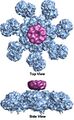 Human apoptosome CARD complex
 -
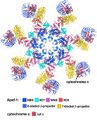 Atomic model of the apoptosome
 -
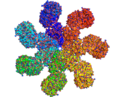 Surface rendering of the apoptosome
 -
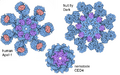 Illustration of apoptosomes


Advertise on WikiMD — 81,000+ full articles, ~900,000 total pages, ~250 million page views. Global reach, limited time promotional rates from $1/page/day. Learn more · View stats

Translate page: - East Asian
中文,
日本,
한국어,
South Asian
हिन्दी,
தமிழ்,
తెలుగు,
Urdu,
ಕನ್ನಡ,
Southeast Asian
Indonesian,
Vietnamese,
Thai,
မြန်မာဘာသာ,
বাংলা
European
español,
Deutsch,
français,
Greek,
português do Brasil,
polski,
română,
русский,
Nederlands,
norsk,
svenska,
suomi,
Italian
Middle Eastern & African
عربى,
Turkish,
Persian,
Hebrew,
Afrikaans,
isiZulu,
Kiswahili,
Other
Bulgarian,
Hungarian,
Czech,
Swedish,
മലയാളം,
मराठी,
ਪੰਜਾਬੀ,
ગુજરાતી,
Portuguese,
Ukrainian
About WikiMD • Contact • Disclaimer • Privacy • Copyright • Site statistics
Some content and images may originate from Wikimedia Commons or Wikipedia and remain subject to their stated licenses. Unless otherwise noted, eligible WikiMD content is available under CC BY-SA 4.0.
WikiMD Wellnesspedia — Free health & wellness information for patients, students, and health professionals.

