Apple butter
| Homemade apple butter | |
| Alternative names | |
| Type | Spread |
| Course | |
| Place of origin | United States |
| Region or state | |
| Associated national cuisine | |
| Created by | |
| Invented | |
| Cooking time | minutes to minutes |
| Serving temperature | |
| Main ingredients | Apples, sugar, spices |
| Ingredients generally used | |
| Variations | |
| Food energy | kcal |
| Nutritional value | Protein: g, Fat: g, Carbohydrate: g |
| Glycemic index | |
| Similar dishes | |
| Other information | |
| Website | [ Official website] |
Apple butter is a highly concentrated form of apple sauce produced by slow-cooking apples with sugar and spices until the sugar in the apples caramelizes, turning the apple butter a deep brown. The concentration of sugar gives apple butter a much longer shelf life as a preserve than apple sauce.
History[edit]
Apple butter originated in Europe during the Middle Ages. It was a way to preserve the fruit for the winter months. The tradition of making apple butter was brought to America by German and Dutch immigrants.
Preparation[edit]
The preparation of apple butter involves cooking apples slowly over low heat. The apples are peeled, cored, and chopped before being cooked. Cinnamon, cloves, and allspice are commonly added to enhance the flavor. The mixture is cooked until it reaches a thick, spreadable consistency.
Uses[edit]
Apple butter is commonly used as a spread on bread, toast, and pancakes. It can also be used as a filling for pastries or as a flavoring in baking.
Nutritional Information[edit]
Apple butter is rich in dietary fiber and contains vitamins such as vitamin C and vitamin A. However, it is also high in sugar and should be consumed in moderation.
See Also[edit]
References[edit]
- "Apple Butter." Wikipedia, The Free Encyclopedia.
- "The History of Apple Butter." Food History.
External Links[edit]
- [Apple Butter Recipe on Wikibooks]()
-
 Beurrée d'nièr beurre black butter on bread
 -
 Apples for apple butter
 -
 Apple butter in jars
 -
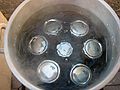 Boiling jars
 -
 Rinse appelstroop on spoon
 -
 Apple sauce vs apple butter
 -
 Apple butter
 -
 Nièr beurre National Trust for Jersey 2007


Medical Disclaimer: WikiMD is for informational purposes only and is not a substitute for professional medical advice. Content may be inaccurate or outdated and should not be used for diagnosis or treatment. Always consult your healthcare provider for medical decisions. Verify information with trusted sources such as CDC.gov and NIH.gov. By using this site, you agree that WikiMD is not liable for any outcomes related to its content. See full disclaimer.
Credits:Most images are courtesy of Wikimedia commons, and templates, categories Wikipedia, licensed under CC BY SA or similar.
Translate page: - East Asian
中文,
日本,
한국어,
South Asian
हिन्दी,
தமிழ்,
తెలుగు,
Urdu,
ಕನ್ನಡ,
Southeast Asian
Indonesian,
Vietnamese,
Thai,
မြန်မာဘာသာ,
বাংলা
European
español,
Deutsch,
français,
Greek,
português do Brasil,
polski,
română,
русский,
Nederlands,
norsk,
svenska,
suomi,
Italian
Middle Eastern & African
عربى,
Turkish,
Persian,
Hebrew,
Afrikaans,
isiZulu,
Kiswahili,
Other
Bulgarian,
Hungarian,
Czech,
Swedish,
മലയാളം,
मराठी,
ਪੰਜਾਬੀ,
ગુજરાતી,
Portuguese,
Ukrainian

