Allium caeruleum
-
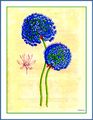 Allium caeruleum illustration by Lemaire
 -
 Allium caeruleum Egyptian Top Onion
 -
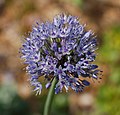 Allium caeruleum Blue Flower Head


Allium caeruleum[edit]
Allium caeruleum, commonly known as the blue globe onion or blue ornamental onion, is a species of flowering plant in the genus Allium. It is native to Central Asia, including regions such as Kazakhstan, Kyrgyzstan, and Xinjiang in China. This species is known for its striking blue flowers and is often cultivated as an ornamental plant in gardens.
Description[edit]
Allium caeruleum is a perennial herbaceous plant that grows from a bulb. The bulbs are typically small, about 1-2 cm in diameter, and produce a single flowering stem that can reach heights of 30-80 cm. The leaves are narrow, linear, and grass-like, usually appearing before the flowering stem.
The flowers of Allium caeruleum are arranged in a spherical umbel, which is a type of inflorescence. Each umbel can contain numerous small, star-shaped flowers that are a vivid blue color, a rare hue among Allium species. The flowering period is typically in late spring to early summer.
Cultivation[edit]
Allium caeruleum is valued in horticulture for its unique blue flowers and is often used in ornamental gardening. It prefers well-drained soil and a sunny location. The plant is relatively drought-tolerant once established and can be propagated by dividing the bulbs or by seed.
In garden settings, Allium caeruleum is often planted in groups to create a striking visual effect. It can be used in rock gardens, flower borders, and as a cut flower. The plant is generally resistant to pests and diseases, making it a low-maintenance choice for gardeners.
Ecology[edit]
In its native habitat, Allium caeruleum grows in steppe and semi-desert regions, often in rocky or sandy soils. It is adapted to the continental climate of Central Asia, with cold winters and hot, dry summers.
The flowers of Allium caeruleum attract a variety of pollinators, including bees and butterflies. The plant plays a role in its native ecosystem by providing nectar and pollen for these insects.
Related pages[edit]

Medical Disclaimer: WikiMD is for informational purposes only and is not a substitute for professional medical advice. Content may be inaccurate or outdated and should not be used for diagnosis or treatment. Always consult your healthcare provider for medical decisions. Verify information with trusted sources such as CDC.gov and NIH.gov. By using this site, you agree that WikiMD is not liable for any outcomes related to its content. See full disclaimer.
Credits:Most images are courtesy of Wikimedia commons, and templates, categories Wikipedia, licensed under CC BY SA or similar.
Translate page: - East Asian
中文,
日本,
한국어,
South Asian
हिन्दी,
தமிழ்,
తెలుగు,
Urdu,
ಕನ್ನಡ,
Southeast Asian
Indonesian,
Vietnamese,
Thai,
မြန်မာဘာသာ,
বাংলা
European
español,
Deutsch,
français,
Greek,
português do Brasil,
polski,
română,
русский,
Nederlands,
norsk,
svenska,
suomi,
Italian
Middle Eastern & African
عربى,
Turkish,
Persian,
Hebrew,
Afrikaans,
isiZulu,
Kiswahili,
Other
Bulgarian,
Hungarian,
Czech,
Swedish,
മലയാളം,
मराठी,
ਪੰਜਾਬੀ,
ગુજરાતી,
Portuguese,
Ukrainian

