Adenosine deaminase 2 deficiency
| Adenosine deaminase 2 deficiency | |
|---|---|

| |
| Synonyms | DADA2, Deficiency of ADA2 |
| Pronounce | N/A |
| Specialty | Rheumatology, Immunology, Hematology |
| Symptoms | Fever, Stroke, Vasculitis, Immunodeficiency, Cytopenia |
| Complications | N/A |
| Onset | Childhood |
| Duration | Lifelong |
| Types | N/A |
| Causes | Mutations in the CECR1 gene |
| Risks | Family history of the condition |
| Diagnosis | Genetic testing, Clinical evaluation |
| Differential diagnosis | Polyarteritis nodosa, Systemic lupus erythematosus, Juvenile idiopathic arthritis |
| Prevention | N/A |
| Treatment | Immunosuppressive therapy, Hematopoietic stem cell transplantation |
| Medication | N/A |
| Prognosis | Variable, depending on severity and treatment |
| Frequency | Rare |
| Deaths | N/A |
Adenosine deaminase 2 deficiency
A rare genetic disorder affecting the immune system
Adenosine deaminase 2 deficiency (DADA2) is a rare genetic disorder characterized by a deficiency in the enzyme adenosine deaminase 2 (ADA2). This condition primarily affects the immune system, leading to a range of symptoms including vasculitis, immunodeficiency, and hematological abnormalities.
Genetics[edit]
DADA2 is inherited in an autosomal recessive pattern, meaning that an individual must inherit two copies of the defective gene, one from each parent, to manifest the disease. The gene responsible for DADA2 is the CECR1 gene, which encodes the ADA2 enzyme. Mutations in this gene lead to reduced or absent activity of ADA2, resulting in the clinical manifestations of the disorder.
Pathophysiology[edit]
The ADA2 enzyme is involved in the breakdown of adenosine and deoxyadenosine, which are important for normal immune function. Deficiency in ADA2 leads to the accumulation of these substrates, causing immune dysregulation and inflammation. The exact mechanisms by which ADA2 deficiency leads to the diverse symptoms observed in DADA2 are still under investigation.
Clinical Features[edit]
Patients with DADA2 may present with a variety of symptoms, including:
- Vasculitis, particularly affecting small and medium-sized blood vessels
- Strokes, often occurring in childhood
- Fever
- Rash
- Hepatosplenomegaly
- Anemia and other blood cell abnormalities
- Immunodeficiency, leading to increased susceptibility to infections
Diagnosis[edit]
The diagnosis of DADA2 is based on clinical evaluation, laboratory findings, and genetic testing. Measurement of ADA2 enzyme activity in the blood can support the diagnosis, but genetic testing for mutations in the CECR1 gene is definitive.
Treatment[edit]
There is no cure for DADA2, but treatment focuses on managing symptoms and preventing complications. Immunosuppressive therapy may be used to control inflammation, and anti-TNF therapy has shown effectiveness in some patients. Hematopoietic stem cell transplantation may be considered in severe cases.
Prognosis[edit]
The prognosis for individuals with DADA2 varies depending on the severity of the symptoms and the effectiveness of treatment. Early diagnosis and management are crucial for improving outcomes.
Related pages[edit]
Gallery[edit]
-
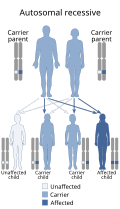 Diagram of autosomal recessive inheritance
Adenosine deaminase 2 deficiency[edit]
Ad. Transform your health with W8MD Weight Loss, Sleep & MedSpa

Tired of being overweight?
Get started with evidence based, physician-supervised
affordable GLP-1 weight loss injections
Now available in New York City and Philadelphia:
- Semaglutide starting from $59.99/week and up
- Tirzepatide starting from $69.99/week and up (dose dependent)
✔ Evidence-based medical weight loss ✔ Insurance-friendly visits available ✔ Same-week appointments, evenings & weekends
Learn more:
Start your transformation today with W8MD weight loss centers.
|
WikiMD Medical Encyclopedia |
Medical Disclaimer: WikiMD is for informational purposes only and is not a substitute for professional medical advice. Content may be inaccurate or outdated and should not be used for diagnosis or treatment. Always consult your healthcare provider for medical decisions. Verify information with trusted sources such as CDC.gov and NIH.gov. By using this site, you agree that WikiMD is not liable for any outcomes related to its content. See full disclaimer.
Credits:Most images are courtesy of Wikimedia commons, and templates, categories Wikipedia, licensed under CC BY SA or similar.
Translate this page: - East Asian
中文,
日本,
한국어,
South Asian
हिन्दी,
தமிழ்,
తెలుగు,
Urdu,
ಕನ್ನಡ,
Southeast Asian
Indonesian,
Vietnamese,
Thai,
မြန်မာဘာသာ,
বাংলা
European
español,
Deutsch,
français,
Greek,
português do Brasil,
polski,
română,
русский,
Nederlands,
norsk,
svenska,
suomi,
Italian
Middle Eastern & African
عربى,
Turkish,
Persian,
Hebrew,
Afrikaans,
isiZulu,
Kiswahili,
Other
Bulgarian,
Hungarian,
Czech,
Swedish,
മലയാളം,
मराठी,
ਪੰਜਾਬੀ,
ગુજરાતી,
Portuguese,
Ukrainian
