Semantic network
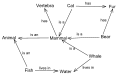
Semantic network is a network that represents semantic relations between concepts. This is often used as a form of knowledge representation. It is a directed or undirected graph consisting of vertices, which represent concepts, and edges, which represent semantic relations between concepts, mapping or connecting semantic fields.
History[edit]
The concept of the Semantic network was introduced in the late 1950s as an attempt to understand and represent knowledge more accurately than was possible with the logical structures then in use. The idea was first proposed by Richard H. Richens of the Cambridge Language Research Unit, as an "Aid to British Council Vocabulary Teaching", in a paper given at the 1956 Mechanical Translation Conference in London.
Structure[edit]
A semantic network is composed of nodes representing concepts, and arcs representing relations between concepts. The nodes are often labeled with concepts, but can also be labeled with any object or event. The arcs are labeled with the type of relation between the concepts.
Types of Semantic Networks[edit]
There are several types of semantic networks, each with its own unique characteristics and uses. These include:
- Definitional networks emphasize the is-a relationship, linking a concept type to a newly defined subtype.
- Assertional networks are used to make assertions about the world and to represent personal knowledge.
- Implicational networks use implication as the primary relationship among nodes.
- Executable networks include procedural information, such as scripts or plans.
Applications[edit]
Semantic networks are used in artificial intelligence where they can aid in solving problems. They are also used in natural language understanding and generation, machine translation, and in the development of user interfaces.
See also[edit]
References[edit]
<references />
| Computer science | ||||||||||
|---|---|---|---|---|---|---|---|---|---|---|
|
Note: This template roughly follows the 2012 ACM Computing Classification System.
|
| Artificial intelligence |
|---|
|
[[File:
_artificial_intelligence_icon.png)
|
| Information science | ||||||||||
|---|---|---|---|---|---|---|---|---|---|---|
This Information science related article is a stub.
|
| Semantic Web | ||||||||||||||||||||||
|---|---|---|---|---|---|---|---|---|---|---|---|---|---|---|---|---|---|---|---|---|---|---|
|
|
|
This computer science related article is a stub. |

-
 Semantic Net

Ad. Transform your health with W8MD Weight Loss, Sleep & MedSpa

Tired of being overweight?
Special offer:
Budget GLP-1 weight loss medications
- Semaglutide starting from $29.99/week and up with insurance for visit of $59.99 and up per week self pay.
- Tirzepatide starting from $45.00/week and up (dose dependent) or $69.99/week and up self pay
✔ Same-week appointments, evenings & weekends
Learn more:
- GLP-1 weight loss clinic NYC
- W8MD's NYC medical weight loss
- W8MD Philadelphia GLP-1 shots
- Philadelphia GLP-1 injections
- Affordable GLP-1 shots NYC
|
WikiMD Medical Encyclopedia |
Medical Disclaimer: WikiMD is for informational purposes only and is not a substitute for professional medical advice. Content may be inaccurate or outdated and should not be used for diagnosis or treatment. Always consult your healthcare provider for medical decisions. Verify information with trusted sources such as CDC.gov and NIH.gov. By using this site, you agree that WikiMD is not liable for any outcomes related to its content. See full disclaimer.
Credits:Most images are courtesy of Wikimedia commons, and templates, categories Wikipedia, licensed under CC BY SA or similar.
Translate this page: - East Asian
中文,
日本,
한국어,
South Asian
हिन्दी,
தமிழ்,
తెలుగు,
Urdu,
ಕನ್ನಡ,
Southeast Asian
Indonesian,
Vietnamese,
Thai,
မြန်မာဘာသာ,
বাংলা
European
español,
Deutsch,
français,
Greek,
português do Brasil,
polski,
română,
русский,
Nederlands,
norsk,
svenska,
suomi,
Italian
Middle Eastern & African
عربى,
Turkish,
Persian,
Hebrew,
Afrikaans,
isiZulu,
Kiswahili,
Other
Bulgarian,
Hungarian,
Czech,
Swedish,
മലയാളം,
मराठी,
ਪੰਜਾਬੀ,
ગુજરાતી,
Portuguese,
Ukrainian
