Senegalia senegal
Senegalia senegal (Fabaceae family), commonly known as Gum Arabic Tree, Acacia Senegal, or Sudan Gum Arabic, is a small to medium-sized thorn tree native to semi-arid regions of Sub-Saharan Africa, India, and Pakistan. This species plays a significant role in the ecosystem and economy of these regions, primarily for its production of gum arabic, a substance widely used in the food industry, pharmaceuticals, and cosmetics.
Description[edit]
Senegalia senegal grows up to 5-12 meters in height, with a dense spheric crown and a thorny, greyish bark. The leaves are bipinnate, with small leaflets, and the flowers are small, bright yellow, and grow in spherical heads. The tree is well adapted to arid environments, thriving in areas with 100-800 mm of annual rainfall.
Distribution and Habitat[edit]
The natural habitat of Senegalia senegal includes a wide range of semi-arid to arid environments, including savannas, grasslands, and woodlands. It is found across the Sahel region of Africa, extending from Senegal to Somalia, and southward to South Africa. It is also native to parts of the Middle East and the Indian subcontinent.
Uses[edit]
The primary use of Senegalia senegal is the production of gum arabic, a sap-like material harvested from the tree's bark. Gum arabic is a valuable emulsifier and stabilizer used in the food and beverage industry, in products such as soft drinks, candies, and gummies. It is also used in pharmaceuticals, cosmetics, and as a binder in watercolor painting and printing.
In addition to gum arabic, the tree is used for fodder, fuelwood, and traditional medicine. The leaves and pods are fed to livestock, and the wood is used for firewood and charcoal production. Various parts of the tree, including the bark, roots, and gum, are used in traditional medicine practices across its native range to treat a variety of ailments.
Conservation and Management[edit]
Senegalia senegal is considered a species of least concern by the International Union for Conservation of Nature (IUCN), but it faces threats from overharvesting, land degradation, and climate change. Sustainable management practices are crucial to ensure the long-term viability of Senegalia senegal populations and the industries dependent on gum arabic production. Efforts include regulated harvesting, reforestation, and research into cultivation practices that could reduce pressure on wild populations.
Cultural Significance[edit]
The tree holds cultural significance in many communities within its range. It is often associated with traditional ceremonies and practices. In some cultures, it is believed to offer protection against evil spirits.
See Also[edit]

Senegalia_senegal[edit]
-
 Khair
Khair -
 Senegalia senegal (kummat)
 -
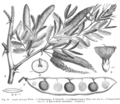 Acacia senegal Taub68

.jpg)

Ad. Transform your life with W8MD's
GLP-1 weight loss injections special from $29.99 with insurance
|
WikiMD Medical Encyclopedia |
Medical Disclaimer: WikiMD is for informational purposes only and is not a substitute for professional medical advice. Content may be inaccurate or outdated and should not be used for diagnosis or treatment. Always consult your healthcare provider for medical decisions. Verify information with trusted sources such as CDC.gov and NIH.gov. By using this site, you agree that WikiMD is not liable for any outcomes related to its content. See full disclaimer.
Credits:Most images are courtesy of Wikimedia commons, and templates, categories Wikipedia, licensed under CC BY SA or similar.
Translate this page: - East Asian
中文,
日本,
한국어,
South Asian
हिन्दी,
தமிழ்,
తెలుగు,
Urdu,
ಕನ್ನಡ,
Southeast Asian
Indonesian,
Vietnamese,
Thai,
မြန်မာဘာသာ,
বাংলা
European
español,
Deutsch,
français,
Greek,
português do Brasil,
polski,
română,
русский,
Nederlands,
norsk,
svenska,
suomi,
Italian
Middle Eastern & African
عربى,
Turkish,
Persian,
Hebrew,
Afrikaans,
isiZulu,
Kiswahili,
Other
Bulgarian,
Hungarian,
Czech,
Swedish,
മലയാളം,
मराठी,
ਪੰਜਾਬੀ,
ગુજરાતી,
Portuguese,
Ukrainian
