Memantine
Medication used to treat Alzheimer's disease
| Memantine | |
|---|---|

| |
| INN | |
| Drug class | |
| Routes of administration | By mouth |
| Pregnancy category | |
| Bioavailability | 100% |
| Metabolism | Hepatic (minimal) |
| Elimination half-life | 60–100 hours |
| Excretion | Renal |
| Legal status | |
| CAS Number | 19982-08-2 |
| PubChem | 4054 |
| DrugBank | DB01043 |
| ChemSpider | 3914 |
| KEGG | D08270 |
Memantine is a medication used to treat moderate-to-severe Alzheimer's disease. It is less preferred than acetylcholinesterase inhibitors such as donepezil and rivastigmine. Memantine is taken by mouth.
Medical uses
Memantine is primarily used for the treatment of Alzheimer's disease. It is believed to work by blocking NMDA receptors, which are involved in synaptic plasticity and memory. This action helps to reduce the symptoms of Alzheimer's disease, such as cognitive decline and memory loss.
Side effects
Common side effects of memantine include dizziness, headache, confusion, and constipation. Serious side effects are rare but can include hallucinations, hypertension, and seizures.
Pharmacology
Memantine is an NMDA receptor antagonist. It binds to the NMDA receptor with a higher affinity than magnesium ions, which are naturally present in the synapse. This binding prevents excessive calcium influx into the neuron, which can lead to neuronal damage and cell death.
Pharmacokinetics
Memantine is well absorbed after oral administration, with a bioavailability of nearly 100%. It is minimally metabolized in the liver and is primarily excreted unchanged in the urine. The elimination half-life of memantine is between 60 and 100 hours.
History
Memantine was first synthesized and developed by Eli Lilly and Company in the 1960s. It was later marketed by Merz Pharmaceuticals under the brand name Namenda. It was approved for the treatment of Alzheimer's disease in the United States by the Food and Drug Administration (FDA) in 2003.
Research
Research is ongoing to explore the potential use of memantine in other neurological disorders, such as Parkinson's disease, Huntington's disease, and multiple sclerosis. Studies are also being conducted to investigate its effects on depression and anxiety.
See also

-
 Memantine
 -
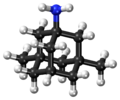 Memantine

Ad. Transform your life with W8MD's Budget GLP-1 injections from $29.99


W8MD offers medical weight loss programs including NYC medical weight loss and Philadelphia medical weight loss offering:
- Affordable GLP1 shots (generic and brand names) such as
- Wegovy NYC (Semaglutide)
- Zepbound NYC /
- Learn more: Budget GLP1 weight loss injections NYC & Philadelphia GLP1 weight loss shots
- Most insurances accepted
- Lowest cost GLP1 weight loss NYC such as Semaglutide starting from $29.99/week and $45.00/week (Tirzepatide) with insurance.
- Prescription weight loss NYC including:
NYC weight loss doctor appointmentsNYC weight loss doctor appointments
Start your physician weight loss journey today at our:
- NYC medical weight loss
- Philadelphia medical weight loss
- Call 718-946-5500 for NYC or 215-676-2334 for Philadelphia
Tags: Budget glp1 weight loss NYC, Zepbound NYC, Philadelphia medical weight loss, Wegovy NYC, Affordable glp1 shots Philadelphia


|
WikiMD's Wellness Encyclopedia |
| Let Food Be Thy Medicine Medicine Thy Food - Hippocrates |
Medical Disclaimer: WikiMD is not a substitute for professional medical advice. The information on WikiMD is provided as an information resource only, may be incorrect, outdated or misleading, and is not to be used or relied on for any diagnostic or treatment purposes. Please consult your health care provider before making any healthcare decisions or for guidance about a specific medical condition. WikiMD expressly disclaims responsibility, and shall have no liability, for any damages, loss, injury, or liability whatsoever suffered as a result of your reliance on the information contained in this site. By visiting this site you agree to the foregoing terms and conditions, which may from time to time be changed or supplemented by WikiMD. If you do not agree to the foregoing terms and conditions, you should not enter or use this site. See full disclaimer.
Credits:Most images are courtesy of Wikimedia commons, and templates, categories Wikipedia, licensed under CC BY SA or similar.
Translate this page: - East Asian
中文,
日本,
한국어,
South Asian
हिन्दी,
தமிழ்,
తెలుగు,
Urdu,
ಕನ್ನಡ,
Southeast Asian
Indonesian,
Vietnamese,
Thai,
မြန်မာဘာသာ,
বাংলা
European
español,
Deutsch,
français,
Greek,
português do Brasil,
polski,
română,
русский,
Nederlands,
norsk,
svenska,
suomi,
Italian
Middle Eastern & African
عربى,
Turkish,
Persian,
Hebrew,
Afrikaans,
isiZulu,
Kiswahili,
Other
Bulgarian,
Hungarian,
Czech,
Swedish,
മലയാളം,
मराठी,
ਪੰਜਾਬੀ,
ગુજરાતી,
Portuguese,
Ukrainian
