Tubocurarine chloride
A naturally occurring alkaloid used as a muscle relaxant
Tubocurarine chloride is a naturally occurring alkaloid that is used as a muscle relaxant in anesthesia. It is derived from the bark and stems of certain species of the plant genus Chondrodendron, particularly Chondrodendron tomentosum. Tubocurarine is one of the active components of curare, a traditional arrow poison used by indigenous peoples of South America.
Chemical structure and properties[edit]

Tubocurarine is a benzylisoquinoline alkaloid. Its chemical formula is C__H__ClN_O_, and it is typically found as a chloride salt. The structure of tubocurarine includes a complex arrangement of rings and a quaternary ammonium group, which is essential for its activity as a neuromuscular blocker.
Mechanism of action[edit]

Tubocurarine acts as a competitive antagonist at the nicotinic acetylcholine receptors located at the neuromuscular junction. By binding to these receptors, it prevents acetylcholine from attaching and triggering muscle contraction, leading to muscle relaxation. This mechanism is utilized during surgical procedures to facilitate endotracheal intubation and to provide muscle relaxation.
Biosynthesis[edit]

The biosynthesis of tubocurarine in plants involves the formation of the benzylisoquinoline skeleton from tyrosine and dopamine precursors. The exact biosynthetic pathway is complex and involves multiple enzymatic steps, leading to the formation of the characteristic alkaloid structure.
Medical use[edit]
Tubocurarine was historically used as a muscle relaxant during anesthesia to facilitate surgical procedures. However, due to its side effects, such as hypotension and histamine release, it has largely been replaced by newer agents with more favorable profiles, such as atracurium and rocuronium.
History[edit]
The use of tubocurarine as a muscle relaxant was first introduced in the 1940s. Its discovery and isolation from curare marked a significant advancement in anesthesiology, allowing for more controlled and safer surgical procedures. The traditional use of curare by indigenous peoples for hunting provided the initial insight into its potential medical applications.
Related pages[edit]
References[edit]
Tubocurarine chloride[edit]
-
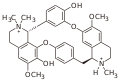 Chemical structure of Tubocurarine
 -
 3D stick model of Tubocurarine
 -
 Proposed biosynthesis pathway of Tubocurarine
 -
 Mechanism of action of acetylcholinesterase

Ad. Transform your health with W8MD Weight Loss, Sleep & MedSpa

Tired of being overweight?
Special offer:
Budget GLP-1 weight loss medications
- Semaglutide starting from $29.99/week and up with insurance for visit of $59.99 and up per week self pay.
- Tirzepatide starting from $45.00/week and up (dose dependent) or $69.99/week and up self pay
✔ Same-week appointments, evenings & weekends
Learn more:
- GLP-1 weight loss clinic NYC
- W8MD's NYC medical weight loss
- W8MD Philadelphia GLP-1 shots
- Philadelphia GLP-1 injections
- Affordable GLP-1 shots NYC
|
WikiMD Medical Encyclopedia |
Medical Disclaimer: WikiMD is for informational purposes only and is not a substitute for professional medical advice. Content may be inaccurate or outdated and should not be used for diagnosis or treatment. Always consult your healthcare provider for medical decisions. Verify information with trusted sources such as CDC.gov and NIH.gov. By using this site, you agree that WikiMD is not liable for any outcomes related to its content. See full disclaimer.
Credits:Most images are courtesy of Wikimedia commons, and templates, categories Wikipedia, licensed under CC BY SA or similar.
Translate this page: - East Asian
中文,
日本,
한국어,
South Asian
हिन्दी,
தமிழ்,
తెలుగు,
Urdu,
ಕನ್ನಡ,
Southeast Asian
Indonesian,
Vietnamese,
Thai,
မြန်မာဘာသာ,
বাংলা
European
español,
Deutsch,
français,
Greek,
português do Brasil,
polski,
română,
русский,
Nederlands,
norsk,
svenska,
suomi,
Italian
Middle Eastern & African
عربى,
Turkish,
Persian,
Hebrew,
Afrikaans,
isiZulu,
Kiswahili,
Other
Bulgarian,
Hungarian,
Czech,
Swedish,
മലയാളം,
मराठी,
ਪੰਜਾਬੀ,
ગુજરાતી,
Portuguese,
Ukrainian
