Valsartan
An angiotensin II receptor blocker used to treat high blood pressure and heart failure
| Valsartan | |
|---|---|

| |
| INN | |
| Drug class | |
| Routes of administration | |
| Pregnancy category | |
| Bioavailability | |
| Metabolism | |
| Elimination half-life | |
| Excretion | |
| Legal status | |
| CAS Number | |
| PubChem | |
| DrugBank | |
| ChemSpider | |
| KEGG | |
Valsartan is a medication that belongs to a class of drugs known as angiotensin II receptor blockers (ARBs). It is primarily used to treat high blood pressure (hypertension), heart failure, and to improve survival after a myocardial infarction (heart attack). Valsartan works by blocking the action of angiotensin II, a chemical in the body that causes blood vessels to tighten and narrow. By blocking this action, valsartan helps to relax and widen blood vessels, which lowers blood pressure and improves blood flow.
Medical uses[edit]
Valsartan is prescribed for the treatment of high blood pressure, heart failure, and to reduce the risk of death after a heart attack. It is often used in patients who cannot tolerate angiotensin-converting enzyme inhibitors (ACE inhibitors). Valsartan may be used alone or in combination with other antihypertensive agents.
Hypertension[edit]
Valsartan is effective in lowering blood pressure in patients with hypertension. It can be used as a monotherapy or in combination with other antihypertensive medications such as hydrochlorothiazide.
Heart failure[edit]
In patients with heart failure, valsartan helps to improve symptoms and reduce hospitalizations. It is often used in conjunction with other heart failure treatments.
Post-myocardial infarction[edit]
Valsartan is used to improve survival and reduce the risk of further cardiovascular events in patients who have experienced a heart attack.
Side effects[edit]
Common side effects of valsartan include dizziness, viral infections, fatigue, and abdominal pain. Serious side effects may include kidney problems, high blood potassium levels, and low blood pressure. Patients are advised to report any unusual symptoms to their healthcare provider.
Mechanism of action[edit]
Valsartan selectively inhibits the binding of angiotensin II to the AT1 receptor, which is found in many tissues, including vascular smooth muscle and the adrenal gland. This inhibition prevents the vasoconstrictor and aldosterone-secreting effects of angiotensin II, leading to a decrease in blood pressure.
Pharmacokinetics[edit]
Valsartan is well absorbed after oral administration, with peak plasma concentrations occurring 2 to 4 hours after dosing. It is highly bound to plasma proteins and is primarily excreted in the feces.
History[edit]
Valsartan was developed by Novartis and was first approved for medical use in 1996. It is available as a generic medication and is widely used around the world.
Related pages[edit]
References[edit]
-
 Chemical structure of Valsartan
 -
 3D model of Valsartan
 -
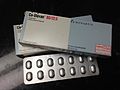 Co-Diovan packaging containing Valsartan

,_Singapore_-_20150210.jpg)
Ad. Transform your life with W8MD's
GLP-1 weight loss injections special from $29.99 with insurance
|
WikiMD Medical Encyclopedia |
Medical Disclaimer: WikiMD is for informational purposes only and is not a substitute for professional medical advice. Content may be inaccurate or outdated and should not be used for diagnosis or treatment. Always consult your healthcare provider for medical decisions. Verify information with trusted sources such as CDC.gov and NIH.gov. By using this site, you agree that WikiMD is not liable for any outcomes related to its content. See full disclaimer.
Credits:Most images are courtesy of Wikimedia commons, and templates, categories Wikipedia, licensed under CC BY SA or similar.
Translate this page: - East Asian
中文,
日本,
한국어,
South Asian
हिन्दी,
தமிழ்,
తెలుగు,
Urdu,
ಕನ್ನಡ,
Southeast Asian
Indonesian,
Vietnamese,
Thai,
မြန်မာဘာသာ,
বাংলা
European
español,
Deutsch,
français,
Greek,
português do Brasil,
polski,
română,
русский,
Nederlands,
norsk,
svenska,
suomi,
Italian
Middle Eastern & African
عربى,
Turkish,
Persian,
Hebrew,
Afrikaans,
isiZulu,
Kiswahili,
Other
Bulgarian,
Hungarian,
Czech,
Swedish,
മലയാളം,
मराठी,
ਪੰਜਾਬੀ,
ગુજરાતી,
Portuguese,
Ukrainian
