P300 (neuroscience)
P300 (neuroscience)
The P300 is a component of the human event-related potential (ERP) that is elicited in the process of decision making. It is considered to be an electroencephalography (EEG) measure of human cognitive function and is most commonly elicited in an "oddball" paradigm when a person experiences rare, unexpected stimuli.
Overview[edit]
The P300 wave is a positive deflection in voltage with a latency of roughly 250 to 500 milliseconds. The exact latency can vary according to the specifics of the stimuli and task. The P300 is most commonly observed from scalp electrodes overlaying the parietal lobe.
Generation[edit]
The generation of the P300 is thought to involve several cortical and subcortical structures, including the hippocampus, basal ganglia, and thalamus. The exact mechanisms underlying the P300 are still not fully understood, but it is thought to reflect processes involved in stimulus evaluation or categorization.
Clinical significance[edit]
The P300 has been used in clinical contexts to assess cognitive function in various neurological and psychiatric conditions, including Alzheimer's disease, schizophrenia, and depression. It has also been used in forensic contexts, such as in the detection of deception or recognition of familiar stimuli in eyewitness testimony.
See also[edit]
References[edit]

This article is a neuroscience stub. You can help WikiMD by expanding it!

-
 P300 latency and amplitude trajectories across the lifespan
 -
 P300 response of different subjects
 -
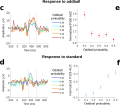 P300 vs oddball probability


Ad. Transform your health with W8MD Weight Loss, Sleep & MedSpa

Tired of being overweight?
Special offer:
Budget GLP-1 weight loss medications
- Semaglutide starting from $29.99/week and up with insurance for visit of $59.99 and up per week self pay.
- Tirzepatide starting from $45.00/week and up (dose dependent) or $69.99/week and up self pay
✔ Same-week appointments, evenings & weekends
Learn more:
- GLP-1 weight loss clinic NYC
- W8MD's NYC medical weight loss
- W8MD Philadelphia GLP-1 shots
- Philadelphia GLP-1 injections
- Affordable GLP-1 shots NYC
|
WikiMD Medical Encyclopedia |
Medical Disclaimer: WikiMD is for informational purposes only and is not a substitute for professional medical advice. Content may be inaccurate or outdated and should not be used for diagnosis or treatment. Always consult your healthcare provider for medical decisions. Verify information with trusted sources such as CDC.gov and NIH.gov. By using this site, you agree that WikiMD is not liable for any outcomes related to its content. See full disclaimer.
Credits:Most images are courtesy of Wikimedia commons, and templates, categories Wikipedia, licensed under CC BY SA or similar.
Translate this page: - East Asian
中文,
日本,
한국어,
South Asian
हिन्दी,
தமிழ்,
తెలుగు,
Urdu,
ಕನ್ನಡ,
Southeast Asian
Indonesian,
Vietnamese,
Thai,
မြန်မာဘာသာ,
বাংলা
European
español,
Deutsch,
français,
Greek,
português do Brasil,
polski,
română,
русский,
Nederlands,
norsk,
svenska,
suomi,
Italian
Middle Eastern & African
عربى,
Turkish,
Persian,
Hebrew,
Afrikaans,
isiZulu,
Kiswahili,
Other
Bulgarian,
Hungarian,
Czech,
Swedish,
മലയാളം,
मराठी,
ਪੰਜਾਬੀ,
ગુજરાતી,
Portuguese,
Ukrainian
