Coloureds: Difference between revisions
CSV import |
CSV import |
||
| Line 38: | Line 38: | ||
[[Category:Multiracial ethnic groups]] | [[Category:Multiracial ethnic groups]] | ||
[[Category:Coloured South African people]] | [[Category:Coloured South African people]] | ||
== Coloureds gallery == | |||
<gallery> | |||
File:Coloured-family.jpg|Coloured family | |||
File:South Africa 2011 Coloured population proportion map.svg|South Africa 2011 Coloured population proportion map | |||
File:South Africa 2011 Coloured population density map.svg|South Africa 2011 Coloured population density map | |||
File:Felix Florez.jpg|Felix Florez | |||
File:Barplots of ancestry proportions South African Coloured population estimated using genome-wide data.png|Barplots of ancestry proportions South African Coloured population estimated using genome-wide data | |||
File:Adam kok III.jpg|Adam Kok III | |||
File:Coloured-Community-of-Nongoma-KwaZulu-Natal-Christmas-Day-early-1900s.png|Coloured Community of Nongoma KwaZulu-Natal Christmas Day early 1900s | |||
File:ApartheidPopulationGroups.jpg|Apartheid Population Groups | |||
</gallery> | |||
Latest revision as of 17:54, 3 March 2025
Ethnic group in Southern Africa
Coloureds are a multiracial ethnic group native to Southern Africa who have ancestry from more than one of the various populations inhabiting the region, including Khoisan, Bantu, European, and Asian ancestry. The term "Coloured" is used primarily in South Africa, Namibia, Botswana, and Zimbabwe.
History[edit]
The origins of the Coloured community can be traced back to the colonial era, when European settlers, primarily from the Netherlands, Germany, and France, arrived in the Cape Colony. These settlers intermarried with the indigenous Khoisan people, as well as with enslaved people brought from other parts of Africa, India, and Indonesia. Over time, a distinct community with a unique cultural identity emerged.
During the apartheid era in South Africa, the government classified people into racial categories, and "Coloured" was one of these categories. Coloured people were subjected to discrimination and segregation, although they were afforded more rights than Black South Africans but fewer than White South Africans.
Culture[edit]
Coloured culture is diverse and includes elements from its various ancestral groups. The community is known for its vibrant music, dance, and cuisine. Afrikaans is widely spoken among Coloured people, although many also speak English.
Music and Dance[edit]
Coloured communities have contributed significantly to South African music, particularly in genres such as jazz, gospel, and hip hop. The Cape Minstrels or "Kaapse Klopse" is a traditional festival celebrated annually in Cape Town, featuring music, dance, and colorful costumes.
Cuisine[edit]
Coloured cuisine is a fusion of different culinary traditions, featuring dishes such as bobotie, sosaties, and koeksisters. These dishes reflect the community's diverse heritage, incorporating spices and techniques from African, European, and Asian cooking.
Demographics[edit]
According to the 2011 South African census, Coloured people make up approximately 8.9% of the country's population. They are predominantly found in the Western Cape and Northern Cape provinces, with significant communities in Gauteng and the Eastern Cape.
Contemporary Issues[edit]
Today, Coloured people in South Africa face various social and economic challenges, including issues related to identity, representation, and access to resources. Despite these challenges, the community continues to play a vital role in the country's cultural and political landscape.
Also see[edit]
| Ethnic groups in South Africa | ||||||||||||||||||||
|---|---|---|---|---|---|---|---|---|---|---|---|---|---|---|---|---|---|---|---|---|
|
Coloureds gallery[edit]
-
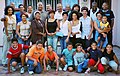 Coloured family
 -
 South Africa 2011 Coloured population proportion map
 -
South Africa 2011 Coloured population density map
-
Felix Florez
-
Barplots of ancestry proportions South African Coloured population estimated using genome-wide data
-
Adam Kok III
-
Coloured Community of Nongoma KwaZulu-Natal Christmas Day early 1900s
-
Apartheid Population Groups


