Moors: Difference between revisions
CSV import |
CSV import |
||
| Line 32: | Line 32: | ||
{{History-stub}} | {{History-stub}} | ||
{{Islam-stub}} | {{Islam-stub}} | ||
<gallery> | |||
File:ChristianAndMuslimPlayingChess.JPG|Christian and Muslim Playing Chess | |||
File:Filà Marraqueix.jpg|Filà Marraqueix | |||
File:Great Mosque of Kairouan Panorama - Grande Mosquée de Kairouan Panorama.jpg|Great Mosque of Kairouan Panorama | |||
File:Moorish ceiling at the Sala de los Reyes, Alhambra.jpg|Moorish ceiling at the Sala de los Reyes, Alhambra | |||
File:MoorsinIberia.jpg|Moors in Iberia | |||
File:Cantigas battle.jpg|Cantigas battle | |||
File:Jaume I, Cantigas de Santa Maria, s.XIII.jpg|Jaume I, Cantigas de Santa Maria, s.XIII | |||
File:MoorandChristianBattle.png|Moor and Christian Battle | |||
File:Alhambra Dec 2004 5.jpg|Alhambra Dec 2004 | |||
File:Book of chess and dice, page 0044R. Arab Muslims in Spain.jpg|Arab Muslims in Spain | |||
</gallery> | |||
Latest revision as of 05:53, 3 March 2025
Moors refers to the Muslim inhabitants of the Maghreb, the Iberian Peninsula, Sicily, and Malta during the Middle Ages, who initially were of Berber and Arab descent from North Africa. The term "Moors" has been used in Europe in a broader, somewhat derogatory sense to refer to Muslims in general, especially those of Arab or Berber descent, whether living in Spain or North Africa.
History[edit]
The Moors arrived in the Iberian Peninsula in 711 AD and called the territory Al-Andalus, which at its peak included most of modern-day Spain, Portugal, and a small part of southern France. They ruled for centuries, contributing significantly to the region's culture and civilization during the Islamic Golden Age.
Culture[edit]
The Moors were known for their advancements in various fields such as mathematics, astronomy, medicine, philosophy, and architecture. They introduced new agricultural methods and brought with them many new crops including sugar cane, rice, citrus fruit, and cotton. The Moors also introduced the Arabic numerals and the concept of zero, which revolutionized mathematics.
Architecture[edit]
Moorish architecture is a variation of Islamic architecture. There are many surviving examples of Moorish architecture in Spain and Portugal, with the Alhambra in Granada, Spain being one of the most notable. Other examples include the Great Mosque of Cordoba and the Giralda in Seville.
Legacy[edit]
The Moors' influence on Spanish and Portuguese culture is evident in various aspects, from language and architecture to music and dance. The flamenco dance and music style, for instance, has Moorish roots. The Moors also left a lasting impact on the region's cuisine, introducing new ingredients and cooking methods.
See also[edit]
This article is a Islam-related stub. You can help WikiMD by expanding it!
-
 Christian and Muslim Playing Chess
 -
 Filà Marraqueix
 -
 Great Mosque of Kairouan Panorama
 -
 Moorish ceiling at the Sala de los Reyes, Alhambra
 -
 Moors in Iberia
 -
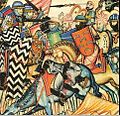 Cantigas battle
 -
Jaume I, Cantigas de Santa Maria, s.XIII
-
Moor and Christian Battle
-
Alhambra Dec 2004
-
Arab Muslims in Spain


