Biobank: Difference between revisions
CSV import Tags: mobile edit mobile web edit |
CSV import |
||
| Line 33: | Line 33: | ||
{{medicine-stub}} | {{medicine-stub}} | ||
== Biobank == | |||
<gallery> | |||
File:PKU-test.jpg|PKU test | |||
</gallery> | |||
Latest revision as of 20:53, 25 February 2025
Biobank is a type of biorepository that stores biological samples (usually human) for use in research. The samples in a biobank are often collected from a wide variety of sources, and can include blood, saliva, plasma, and purified DNA. Biobanks give researchers access to data representing a large number of people. Samples in biobanks and the data derived from those samples can often be used by multiple researchers for multiple projects, which can increase the speed and efficiency of medical research.
History[edit]
The concept of a biobank has been around for several decades, but the term "biobank" was first used in the late 1990s. The first modern biobanks were established in the 1950s and 1960s, with the advent of freezing technology that could reliably preserve biological samples.
Types of Biobanks[edit]
There are several different types of biobanks, including:
- Population-based biobanks, which collect samples from a large cross-section of the population. These biobanks are often used in epidemiology and genetic research.
- Disease-based biobanks, which collect samples from patients with a specific disease. These biobanks are often used in clinical research and drug development.
- Tissue banks, which store human tissues for transplantation, research, and education.
Ethical and Legal Issues[edit]
Biobanks raise a number of ethical and legal issues, including privacy, consent, and the ownership of biological samples. In many countries, these issues are addressed through legislation and regulation.
See Also[edit]

Biobank[edit]
-
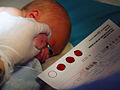 PKU test

