Beta oxidation: Difference between revisions
CSV import Tags: mobile edit mobile web edit |
CSV import Tags: mobile edit mobile web edit |
||
| Line 27: | Line 27: | ||
[[Category:Biochemistry]] | [[Category:Biochemistry]] | ||
{{biochemistry-stub}} | {{biochemistry-stub}} | ||
== Beta_oxidation == | |||
<gallery> | |||
File:Metabolism1.jpg|Metabolism1 | |||
File:Metabolism2.jpg|Metabolism2 | |||
File:Metabolism3.jpg|Metabolism3 | |||
File:Metabolism4.jpg|Metabolism4 | |||
File:Beta_oxidation_Anindita.jpg|Beta oxidation Anindita | |||
File:Beta-Oxidation1.svg|Beta-Oxidation1 | |||
File:Beta-Oxidation2.svg|Beta-Oxidation2 | |||
File:Beta-Oxidation3.svg|Beta-Oxidation3 | |||
File:Beta-Oxidation4.svg|Beta-Oxidation4 | |||
File:Odd-chain_FA_oxydation.png|Odd-chain FA oxydation | |||
File:Linoleic_acid_beta_oxidation.svg|Linoleic acid beta oxidation | |||
File:Steps-in-b-oxidation-of-odd-numbered-saturated-fatty-acid.png|Steps in b-oxidation of odd-numbered saturated fatty acid | |||
</gallery> | |||
Latest revision as of 21:22, 23 February 2025
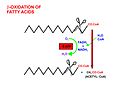
Beta oxidation is a metabolic process involving multiple steps by which fatty acid molecules are broken down within the mitochondria in eukaryotic cells, and in the cytoplasm of prokaryotic cells. This process generates acetyl-CoA, which enters the citric acid cycle, and NADH and FADH2, which are co-enzymes used in the electron transport chain. It is named 'beta oxidation' because the beta carbon of the fatty acid undergoes oxidation to a carbonyl group.
Process[edit]
Beta oxidation consists of four steps: dehydrogenation, hydration, another dehydrogenation, and finally thiolytic cleavage. Each step is facilitated by a specific enzyme.
- Dehydrogenation: The first step in beta oxidation is the oxidation of the fatty acid by acyl-CoA dehydrogenase to create a trans double bond between the alpha and beta carbons. This process generates one molecule of FADH2.
- Hydration: In the second step, water is added to the fatty acid by enoyl-CoA hydratase to form a beta-hydroxy group. This step is an example of stereospecificity, as only the L isomer of the molecule is produced.
- Second Dehydrogenation: The third step is another oxidation, this time of the beta-hydroxy group to a keto group. This step is catalyzed by hydroxyacyl-CoA dehydrogenase, and generates one molecule of NADH.
- Thiolytic Cleavage: The final step is the cleavage of the beta-ketoacyl CoA by thiolase, releasing an acetyl-CoA molecule and a fatty acid chain shortened by two carbon atoms.
Regulation[edit]
Beta oxidation is regulated by a number of factors, including the availability of fatty acids, the levels of malonyl-CoA, and the energy status of the cell. The rate of beta oxidation can be increased by exercise, fasting, and low-carbohydrate diets.
Clinical Significance[edit]
Defects in beta oxidation can lead to a number of metabolic disorders, including medium-chain acyl-CoA dehydrogenase deficiency (MCADD), long-chain 3-hydroxyacyl-CoA dehydrogenase deficiency (LCHADD), and carnitine deficiency. These conditions can lead to symptoms such as hypoglycemia, lethargy, and muscle weakness, and can be life-threatening if not properly managed.
See Also[edit]
.svg)
This article is a biochemistry stub. You can help WikiMD by expanding it!
Beta_oxidation[edit]
-
 Metabolism1
 -
 Metabolism2
 -
 Metabolism3
 -
 Metabolism4
 -
 Beta oxidation Anindita
 -
 Beta-Oxidation1
 -
 Beta-Oxidation2
 -
 Beta-Oxidation3
 -
 Beta-Oxidation4
 -
 Odd-chain FA oxydation
 -
 Linoleic acid beta oxidation
 -
 Steps in b-oxidation of odd-numbered saturated fatty acid


