Thiolase
Thiolase, also known as acetoacetyl-CoA acetyltransferase, is an enzyme that plays a fundamental role in metabolic processes. It is involved in the ketogenesis pathway, fatty acid metabolism, and the mevalonate pathway, which is responsible for the synthesis of sterols and other isoprenoids.
Function[edit]
Thiolase catalyzes the last step of the beta-oxidation cycle, a metabolic pathway involved in the breakdown of fatty acids. This reaction involves the cleavage of acetoacetyl CoA into two molecules of acetyl CoA. Thiolase also plays a role in the synthesis of ketone bodies, which are produced in the liver and used as an energy source by the brain during periods of fasting.
Structure[edit]
Thiolase is a dimeric enzyme, meaning it is composed of two identical subunits. Each subunit contains a catalytic triad consisting of three amino acids: cysteine, histidine, and aspartate. The cysteine residue is responsible for the enzyme's thiolase activity.
Clinical significance[edit]
Mutations in the gene encoding thiolase can lead to a rare metabolic disorder known as beta-ketothiolase deficiency. This condition is characterized by an inability to effectively break down certain amino acids and lipids, leading to a buildup of harmful substances in the body.
See also[edit]
References[edit]
 | This enzyme-related article is a stub. You can help WikiMD by expanding the page. |
 | This medical article is a stub. You can help WikiMD by expanding the page. |
-
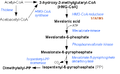 Mevalonate pathway
 -
Thiolase reaction catalysis
-
Thiolase mechanism


Medical Disclaimer: WikiMD is for informational purposes only and is not a substitute for professional medical advice. Content may be inaccurate or outdated and should not be used for diagnosis or treatment. Always consult your healthcare provider for medical decisions. Verify information with trusted sources such as CDC.gov and NIH.gov. By using this site, you agree that WikiMD is not liable for any outcomes related to its content. See full disclaimer.
Credits:Most images are courtesy of Wikimedia commons, and templates, categories Wikipedia, licensed under CC BY SA or similar.
Translate page: - East Asian
中文,
日本,
한국어,
South Asian
हिन्दी,
தமிழ்,
తెలుగు,
Urdu,
ಕನ್ನಡ,
Southeast Asian
Indonesian,
Vietnamese,
Thai,
မြန်မာဘာသာ,
বাংলা
European
español,
Deutsch,
français,
Greek,
português do Brasil,
polski,
română,
русский,
Nederlands,
norsk,
svenska,
suomi,
Italian
Middle Eastern & African
عربى,
Turkish,
Persian,
Hebrew,
Afrikaans,
isiZulu,
Kiswahili,
Other
Bulgarian,
Hungarian,
Czech,
Swedish,
മലയാളം,
मराठी,
ਪੰਜਾਬੀ,
ગુજરાતી,
Portuguese,
Ukrainian


