Memantine: Difference between revisions
CSV import |
CSV import |
||
| Line 76: | Line 76: | ||
[[Category:Medicine]] | [[Category:Medicine]] | ||
{{medicine-stub}} | {{medicine-stub}} | ||
<gallery> | |||
File:Memantine structure.svg|Memantine | |||
File:Memantine ball-and-stick model.png|Memantine | |||
</gallery> | |||
<gallery> | <gallery> | ||
File:Memantine structure.svg|Memantine | File:Memantine structure.svg|Memantine | ||
File:Memantine ball-and-stick model.png|Memantine | File:Memantine ball-and-stick model.png|Memantine | ||
</gallery> | </gallery> | ||
Revision as of 01:37, 20 February 2025
Medication used to treat Alzheimer's disease
| Memantine | |
|---|---|

| |
| INN | |
| Drug class | |
| Routes of administration | By mouth |
| Pregnancy category | |
| Bioavailability | 100% |
| Metabolism | Hepatic (minimal) |
| Elimination half-life | 60–100 hours |
| Excretion | Renal |
| Legal status | |
| CAS Number | 19982-08-2 |
| PubChem | 4054 |
| DrugBank | DB01043 |
| ChemSpider | 3914 |
| KEGG | D08270 |
Memantine is a medication used to treat moderate-to-severe Alzheimer's disease. It is less preferred than acetylcholinesterase inhibitors such as donepezil and rivastigmine. Memantine is taken by mouth.
Medical uses
Memantine is primarily used for the treatment of Alzheimer's disease. It is believed to work by blocking NMDA receptors, which are involved in synaptic plasticity and memory. This action helps to reduce the symptoms of Alzheimer's disease, such as cognitive decline and memory loss.
Side effects
Common side effects of memantine include dizziness, headache, confusion, and constipation. Serious side effects are rare but can include hallucinations, hypertension, and seizures.
Pharmacology
Memantine is an NMDA receptor antagonist. It binds to the NMDA receptor with a higher affinity than magnesium ions, which are naturally present in the synapse. This binding prevents excessive calcium influx into the neuron, which can lead to neuronal damage and cell death.
Pharmacokinetics
Memantine is well absorbed after oral administration, with a bioavailability of nearly 100%. It is minimally metabolized in the liver and is primarily excreted unchanged in the urine. The elimination half-life of memantine is between 60 and 100 hours.
History
Memantine was first synthesized and developed by Eli Lilly and Company in the 1960s. It was later marketed by Merz Pharmaceuticals under the brand name Namenda. It was approved for the treatment of Alzheimer's disease in the United States by the Food and Drug Administration (FDA) in 2003.
Research
Research is ongoing to explore the potential use of memantine in other neurological disorders, such as Parkinson's disease, Huntington's disease, and multiple sclerosis. Studies are also being conducted to investigate its effects on depression and anxiety.
See also

-
 Memantine
 -
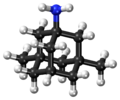 Memantine

-
Memantine
-
Memantine
