Cyclic nucleotide–gated ion channel: Difference between revisions
CSV import |
CSV import |
||
| Line 26: | Line 26: | ||
{{Cell-biology-stub}} | {{Cell-biology-stub}} | ||
{{Neuroscience-stub}} | {{Neuroscience-stub}} | ||
<gallery> | |||
File:Signal transduction in sea-urchin sperm chemotaxis.jpg|Signal transduction in sea-urchin sperm chemotaxis | |||
File:Cyclic-adenosine-monophosphate-2D-skeletal.png|Cyclic adenosine monophosphate 2D skeletal | |||
File:CGMP.png|CGMP | |||
File:PDB 1wgp EBI.jpg|PDB 1wgp EBI | |||
File:Fundus of patient with retinitis pigmentosa, mid stage.jpg|Fundus of patient with retinitis pigmentosa, mid stage | |||
File:Structure of a Prokaryotic CNG Channel.jpg|Structure of a Prokaryotic CNG Channel | |||
</gallery> | |||
Latest revision as of 01:09, 20 February 2025
Cyclic nucleotide–gated (CNG) ion channels are ion channels that function in response to the binding of cyclic nucleotides. CNG channels are nonselective cation channels that are found in the membranes of various tissue and cell types, and are significant in sensory transduction as well as cellular development.
Structure[edit]
CNG channels are composed of a tetramer of subunits, each containing six membrane-spanning segments (S1-S6). The pore region is formed by the S5 and S6 segments and the connecting loop. The S4 segment acts as the voltage sensor. The C-linker region, located between the S6 segment and the cyclic nucleotide-binding domain (CNBD), is critical for channel gating.
Function[edit]
CNG channels play a crucial role in signal transduction pathways. They are involved in the conversion of sensory information into electrical signals, particularly in vision and olfaction. In the retina, CNG channels are involved in phototransduction, the process by which light is converted into electrical signals. In olfactory sensory neurons, CNG channels mediate signal transduction for odor detection.
Clinical significance[edit]
Mutations in CNG channel genes have been associated with various diseases. For example, mutations in the genes encoding the alpha subunits of rod and cone CNG channels can lead to retinitis pigmentosa and achromatopsia, respectively.
See also[edit]
References[edit]
<references />

This article is a cell biology stub. You can help WikiMD by expanding it!

This article is a neuroscience stub. You can help WikiMD by expanding it!
-
 Signal transduction in sea-urchin sperm chemotaxis
 -
 Cyclic adenosine monophosphate 2D skeletal
 -
 CGMP
CGMP -
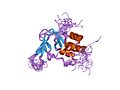 PDB 1wgp EBI
 -
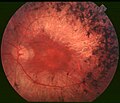 Fundus of patient with retinitis pigmentosa, mid stage
 -
 Structure of a Prokaryotic CNG Channel


