Epilepsy in children: Difference between revisions
CSV import |
CSV import |
||
| Line 27: | Line 27: | ||
{{neurology-stub}} | {{neurology-stub}} | ||
{{medicine-stub}} | {{medicine-stub}} | ||
== Epilepsy in children == | |||
<gallery> | |||
File:Spike-waves.png|Spike-waves | |||
File:Figure 6 Image of EEG (Nunez 2002).png|EEG Image | |||
</gallery> | |||
Latest revision as of 01:07, 20 February 2025
Epilepsy in children is a neurological disorder characterized by recurrent, unprovoked seizures. It is one of the most common chronic neurological disorders in children, affecting approximately 0.5-1% of the population. The condition can have a significant impact on a child's life, affecting their development, learning, behavior, and overall quality of life.
Etiology[edit]
The cause of epilepsy in children is often unknown, but it can be linked to a variety of factors. These include genetic predisposition, brain malformations, neonatal seizures, febrile seizures, central nervous system infections, and traumatic brain injury. In some cases, epilepsy can be a symptom of a larger syndrome or disease, such as Rett syndrome, Tuberous sclerosis, or Dravet syndrome.
Diagnosis[edit]
Diagnosis of epilepsy in children is based on the child's medical history, a physical and neurological examination, and the results of diagnostic tests. These tests may include an electroencephalogram (EEG), which records the electrical activity of the brain, and imaging studies such as magnetic resonance imaging (MRI) or computed tomography (CT) scans.
Treatment[edit]
Treatment for epilepsy in children aims to control seizures, prevent complications, and enable the child to lead a normal life. This may involve the use of antiepileptic drugs, ketogenic diet, vagus nerve stimulation, or in severe cases, epilepsy surgery. The choice of treatment depends on the type of seizures, the child's age, the cause of epilepsy, and the child's overall health.
Prognosis[edit]
The prognosis for children with epilepsy varies widely. Some children outgrow their seizures as they get older, while others may have lifelong epilepsy. The prognosis is generally better for children who have a known cause of epilepsy, respond well to treatment, and have a normal neurological examination.
See also[edit]
This article is a medical stub. You can help WikiMD by expanding it!
Epilepsy in children[edit]
-
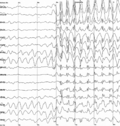 Spike-waves
 -
 EEG Image

.png)

