Appendix cancer: Difference between revisions
CSV import |
CSV import Tags: mobile edit mobile web edit |
||
| Line 5: | Line 5: | ||
File:Histopathology_of_low-grade_appendiceal_mucinous_neoplasm.jpg|Histopathology of low-grade appendiceal mucinous neoplasm | File:Histopathology_of_low-grade_appendiceal_mucinous_neoplasm.jpg|Histopathology of low-grade appendiceal mucinous neoplasm | ||
</gallery> | </gallery> | ||
Appendix Cancer | |||
Appendix cancer is a rare type of cancer that occurs in the [[appendix]], a small, tube-shaped pouch attached to the large intestine. This type of cancer can be challenging to diagnose due to its rarity and the non-specific nature of its symptoms. | |||
==Types== | |||
Appendix cancer can be classified into several types based on the type of cells involved: | |||
* '''[[Carcinoid tumors]]''': These are the most common type of appendix cancer and originate from the hormone-producing cells of the appendix. They are often slow-growing and may not cause symptoms until they are advanced. | |||
* '''[[Adenocarcinoma]]''': This type of cancer arises from the glandular cells lining the appendix. It is more aggressive than carcinoid tumors and can spread to other parts of the body. | |||
* '''[[Mucinous adenocarcinoma]]''': This subtype is characterized by the production of mucin, a jelly-like substance. It can lead to a condition known as [[pseudomyxoma peritonei]], where mucin accumulates in the abdominal cavity. | |||
* '''[[Signet ring cell carcinoma]]''': A rare and aggressive form of adenocarcinoma, signet ring cell carcinoma is named for the appearance of the cancer cells under a microscope. | |||
* '''[[Goblet cell carcinoid]]''': This is a hybrid tumor with features of both adenocarcinoma and carcinoid tumors. It tends to be more aggressive than typical carcinoid tumors. | |||
==Symptoms== | |||
Symptoms of appendix cancer can be vague and may include: | |||
* Abdominal pain or discomfort | |||
* Bloating or a feeling of fullness | |||
* Changes in bowel habits | |||
* Unexplained weight loss | |||
* Nausea and vomiting | |||
In some cases, appendix cancer is discovered incidentally during surgery for another condition, such as [[appendicitis]]. | |||
==Diagnosis== | |||
Diagnosis of appendix cancer typically involves a combination of: | |||
* [[Imaging studies]]: Such as [[CT scan]]s or [[MRI]]s to visualize the appendix and surrounding tissues. | |||
* [[Biopsy]]: A sample of tissue may be taken to confirm the diagnosis and determine the type of cancer. | |||
* [[Blood tests]]: To check for tumor markers and assess overall health. | |||
==Treatment== | |||
Treatment options for appendix cancer depend on the type and stage of the cancer and may include: | |||
* '''[[Surgery]]''': The primary treatment for localized appendix cancer is surgical removal of the appendix, often along with part of the colon and surrounding tissues. | |||
* '''[[Chemotherapy]]''': Used to kill cancer cells or shrink tumors, especially in cases where the cancer has spread. | |||
* '''[[Cytoreductive surgery]] and [[hyperthermic intraperitoneal chemotherapy]] (HIPEC)''': A specialized treatment for pseudomyxoma peritonei, involving the surgical removal of tumors followed by the direct application of heated chemotherapy to the abdominal cavity. | |||
==Prognosis== | |||
The prognosis for appendix cancer varies widely depending on the type and stage of the cancer. Carcinoid tumors generally have a better prognosis than adenocarcinomas. Early detection and treatment are crucial for improving outcomes. | |||
==Related pages== | |||
* [[Appendicitis]] | |||
* [[Gastrointestinal cancer]] | |||
* [[Neuroendocrine tumor]] | |||
{{Medical resources}} | |||
[[Category:Types of cancer]] | |||
[[Category:Gastroenterology]] | |||
[[Category:Rare diseases]] | |||
Revision as of 00:41, 19 February 2025
-
 Appendiceal carcinoid tumor
 -
 Appendix neoplasms by incidence and prognosis
 -
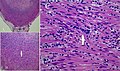 Histopathology of appendiceal carcinoid
 -
 Histopathology of low-grade appendiceal mucinous neoplasm


Appendix Cancer
Appendix cancer is a rare type of cancer that occurs in the appendix, a small, tube-shaped pouch attached to the large intestine. This type of cancer can be challenging to diagnose due to its rarity and the non-specific nature of its symptoms.
Types
Appendix cancer can be classified into several types based on the type of cells involved:
- Carcinoid tumors: These are the most common type of appendix cancer and originate from the hormone-producing cells of the appendix. They are often slow-growing and may not cause symptoms until they are advanced.
- Adenocarcinoma: This type of cancer arises from the glandular cells lining the appendix. It is more aggressive than carcinoid tumors and can spread to other parts of the body.
- Mucinous adenocarcinoma: This subtype is characterized by the production of mucin, a jelly-like substance. It can lead to a condition known as pseudomyxoma peritonei, where mucin accumulates in the abdominal cavity.
- Signet ring cell carcinoma: A rare and aggressive form of adenocarcinoma, signet ring cell carcinoma is named for the appearance of the cancer cells under a microscope.
- Goblet cell carcinoid: This is a hybrid tumor with features of both adenocarcinoma and carcinoid tumors. It tends to be more aggressive than typical carcinoid tumors.
Symptoms
Symptoms of appendix cancer can be vague and may include:
- Abdominal pain or discomfort
- Bloating or a feeling of fullness
- Changes in bowel habits
- Unexplained weight loss
- Nausea and vomiting
In some cases, appendix cancer is discovered incidentally during surgery for another condition, such as appendicitis.
Diagnosis
Diagnosis of appendix cancer typically involves a combination of:
- Imaging studies: Such as CT scans or MRIs to visualize the appendix and surrounding tissues.
- Biopsy: A sample of tissue may be taken to confirm the diagnosis and determine the type of cancer.
- Blood tests: To check for tumor markers and assess overall health.
Treatment
Treatment options for appendix cancer depend on the type and stage of the cancer and may include:
- Surgery: The primary treatment for localized appendix cancer is surgical removal of the appendix, often along with part of the colon and surrounding tissues.
- Chemotherapy: Used to kill cancer cells or shrink tumors, especially in cases where the cancer has spread.
- Cytoreductive surgery and hyperthermic intraperitoneal chemotherapy (HIPEC): A specialized treatment for pseudomyxoma peritonei, involving the surgical removal of tumors followed by the direct application of heated chemotherapy to the abdominal cavity.
Prognosis
The prognosis for appendix cancer varies widely depending on the type and stage of the cancer. Carcinoid tumors generally have a better prognosis than adenocarcinomas. Early detection and treatment are crucial for improving outcomes.
