Dinoseb: Difference between revisions
CSV import Tags: mobile edit mobile web edit |
CSV import |
||
| Line 31: | Line 31: | ||
{{chemistry-stub}} | {{chemistry-stub}} | ||
{{medicine-stub}} | {{medicine-stub}} | ||
<gallery> | |||
File:Dinoseb_metabolism.png|Dinoseb metabolism | |||
File:Thylakoid_membrane_3.svg|Thylakoid membrane | |||
File:Synthesis_1.jpg|Synthesis 1 | |||
File:Synthesis_2.jpg|Synthesis 2 | |||
File:Synthesis_of_dinoseb_step_3.jpg|Synthesis of dinoseb step 3 | |||
File:Synthesis_4.jpg|Synthesis 4 | |||
File:(S)-Dinoseb_V1.svg|(S)-Dinoseb | |||
File:(R)-Dinoseb_V1.svg|(R)-Dinoseb | |||
</gallery> | |||
Latest revision as of 11:24, 18 February 2025
Dinoseb is an organic compound that is commonly used as a herbicide. It is a yellow, crystalline solid that is soluble in water and most organic solvents. Dinoseb is known for its high toxicity and potential for causing harm to both humans and the environment.
Chemical Properties[edit]
Dinoseb is a phenol derivative, specifically a dinitrophenol, and its chemical formula is C6H4N2O5. It has a molecular weight of 225.11 g/mol. The compound is highly reactive and can undergo various chemical reactions, including oxidation and reduction.
Uses[edit]
Historically, dinoseb was widely used as a herbicide and pesticide. It was effective in controlling a wide range of weeds and pests in various crops, including soybeans, corn, and cotton. However, due to its high toxicity and potential for environmental harm, its use has been severely restricted in many countries.
Health Effects[edit]
Exposure to dinoseb can cause a variety of health effects. Acute exposure can lead to symptoms such as nausea, vomiting, headache, and dizziness. Chronic exposure can lead to more serious health problems, including liver damage, kidney damage, and cancer. Dinoseb is also known to be a potential endocrine disruptor.
Environmental Impact[edit]
Dinoseb is highly toxic to aquatic life and can cause long-term damage to aquatic ecosystems. It is also persistent in the environment and can accumulate in the food chain, posing a risk to wildlife and humans.
Regulation[edit]
Due to its high toxicity and environmental impact, the use of dinoseb has been banned or restricted in many countries. In the United States, the Environmental Protection Agency (EPA) banned the use of dinoseb in 1986.
See Also[edit]


-
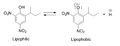 Dinoseb metabolism
 -
 Thylakoid membrane
 -
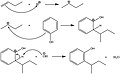 Synthesis 1
 -
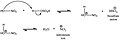 Synthesis 2
 -
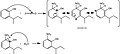 Synthesis of dinoseb step 3
 -
Synthesis 4
-
(S)-Dinoseb
-
(R)-Dinoseb


-Dinoseb_V1.svg)
-Dinoseb_V1.svg)