Coconut crab: Difference between revisions
CSV import Tags: mobile edit mobile web edit |
CSV import |
||
| Line 28: | Line 28: | ||
{{Crustacean-stub}} | {{Crustacean-stub}} | ||
{{food-stub}} | {{food-stub}} | ||
<gallery> | |||
File:Coconut_Crab_Birgus_latro.jpg|Coconut crab in its natural habitat | |||
File:Palmyra_Atoll_National_Wildlife_Refuge,_Pacific_Islands_(6109853163).jpg|Palmyra Atoll, a habitat of the coconut crab | |||
File:CoconutCrabDictionnaireDHistoireNaturelle1849.jpg|Illustration of a coconut crab from 1849 | |||
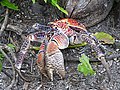
File:Birgus_latro.jpg|Close-up of a coconut crab | |||
File:Birgus_latro_(Bora-Bora).jpg|Coconut crab on Bora Bora | |||
</gallery> | |||
Latest revision as of 04:59, 18 February 2025
Coconut crab (Birgus latro) is a species of terrestrial hermit crab, also known as the robber crab or palm thief. It is the largest land-living arthropod in the world, and is probably at the upper size limit for terrestrial animals with exoskeletons in recent Earth atmosphere, with a weight of up to 4.1 kg (9.0 lb). It can grow up to 1 m (3 ft 3 in) in length from leg to leg. It is found on islands across the Indian Ocean and parts of the Pacific Ocean.
Description[edit]
The coconut crab has a body length of up to 40 cm (16 in), a leg span of over 0.91 m (3.0 ft), and a weight of up to 4.1 kg (9.0 lb). Apart from its size, the coconut crab is also notable for its ability to climb trees and its strong pincers, which can crack open coconuts.
Distribution and habitat[edit]
The coconut crab is found on islands across the Indian Ocean and parts of the Pacific Ocean. Its range includes the Andaman Islands, the Seychelles, the Maldives, and the Chagos Archipelago in the Indian Ocean, and the Cook Islands, Kiribati, Samoa, and Tonga in the Pacific Ocean.
Behavior and ecology[edit]
Coconut crabs are solitary animals, spending most of their time in burrows or rock crevices. They are primarily nocturnal, but can be active during the day in overcast conditions or after rain. They are omnivorous, feeding on fruits, nuts, seeds, and the pith of fallen trees, but will also eat carrion and other organic matter.
Conservation[edit]
The coconut crab is not currently considered endangered, but its population is thought to be declining due to habitat loss and over-hunting. In some areas, such as the Cook Islands, it is illegal to hunt or capture coconut crabs.
See also[edit]
References[edit]
<references />
.png)
This article is a crustacean-related stub. You can help WikiMD by expanding it!

-
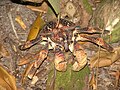 Coconut crab in its natural habitat
 -
 Palmyra Atoll, a habitat of the coconut crab
 -
 Illustration of a coconut crab from 1849
 -
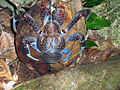 Close-up of a coconut crab
 -
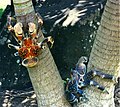 Coconut crab on Bora Bora

.jpg)


.jpg)
