Tubocurarine chloride: Difference between revisions
CSV import |
CSV import |
||
| Line 33: | Line 33: | ||
[[Category:Muscle relaxants]] | [[Category:Muscle relaxants]] | ||
[[Category:Anesthesia]] | [[Category:Anesthesia]] | ||
== Tubocurarine chloride == | |||
<gallery> | |||
File:Tubocurarine.svg|Chemical structure of Tubocurarine | |||
File:Tubocurarine-3D-sticks.png|3D stick model of Tubocurarine | |||
File:Tubocurarine_proposed_biosynthesis.png|Proposed biosynthesis pathway of Tubocurarine | |||
File:AChe_mechanism_of_action.jpg|Mechanism of action of acetylcholinesterase | |||
</gallery> | |||
Latest revision as of 04:39, 18 February 2025
A naturally occurring alkaloid used as a muscle relaxant
Tubocurarine chloride is a naturally occurring alkaloid that is used as a muscle relaxant in anesthesia. It is derived from the bark and stems of certain species of the plant genus Chondrodendron, particularly Chondrodendron tomentosum. Tubocurarine is one of the active components of curare, a traditional arrow poison used by indigenous peoples of South America.
Chemical structure and properties[edit]

Tubocurarine is a benzylisoquinoline alkaloid. Its chemical formula is C__H__ClN_O_, and it is typically found as a chloride salt. The structure of tubocurarine includes a complex arrangement of rings and a quaternary ammonium group, which is essential for its activity as a neuromuscular blocker.
Mechanism of action[edit]

Tubocurarine acts as a competitive antagonist at the nicotinic acetylcholine receptors located at the neuromuscular junction. By binding to these receptors, it prevents acetylcholine from attaching and triggering muscle contraction, leading to muscle relaxation. This mechanism is utilized during surgical procedures to facilitate endotracheal intubation and to provide muscle relaxation.
Biosynthesis[edit]

The biosynthesis of tubocurarine in plants involves the formation of the benzylisoquinoline skeleton from tyrosine and dopamine precursors. The exact biosynthetic pathway is complex and involves multiple enzymatic steps, leading to the formation of the characteristic alkaloid structure.
Medical use[edit]
Tubocurarine was historically used as a muscle relaxant during anesthesia to facilitate surgical procedures. However, due to its side effects, such as hypotension and histamine release, it has largely been replaced by newer agents with more favorable profiles, such as atracurium and rocuronium.
History[edit]
The use of tubocurarine as a muscle relaxant was first introduced in the 1940s. Its discovery and isolation from curare marked a significant advancement in anesthesiology, allowing for more controlled and safer surgical procedures. The traditional use of curare by indigenous peoples for hunting provided the initial insight into its potential medical applications.
Related pages[edit]
References[edit]
<references group="" responsive="1"></references>
Tubocurarine chloride[edit]
-
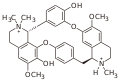 Chemical structure of Tubocurarine
 -
 3D stick model of Tubocurarine
 -
 Proposed biosynthesis pathway of Tubocurarine
 -
 Mechanism of action of acetylcholinesterase

