Earth's crust: Difference between revisions
CSV import |
CSV import |
||
| Line 30: | Line 30: | ||
{{Geology-stub}} | {{Geology-stub}} | ||
<gallery> | |||
File:Tectonic_plates_2022.svg|Map of tectonic plates | |||
File:World_relief_map_with_isopachs_of_crustal_thickness.jpg|World relief map with isopachs of crustal thickness | |||
File:Elemental_abundances.svg|Elemental abundances in Earth's crust | |||
</gallery> | |||
Latest revision as of 03:56, 18 February 2025
Earth's crust is the outermost solid shell of the planet Earth. It is composed of a variety of igneous, metamorphic, and sedimentary rocks. The Earth's crust is subdivided into two types: the oceanic crust, which underlies the oceans, and the continental crust, which underlies the continents.
Composition and Structure[edit]
The crust is composed primarily of silicate minerals, which include minerals such as quartz, feldspar, and mica. These minerals are the building blocks of the rocks that make up the Earth's crust. The oceanic crust is mainly composed of basalt, a dense, dark igneous rock, while the continental crust is primarily composed of less dense, lighter-colored rocks such as granite.
The thickness of the Earth's crust varies significantly. The oceanic crust is typically 5-10 kilometers thick, while the continental crust can be up to 70 kilometers thick in some areas. The boundary between the crust and the underlying mantle is known as the Mohorovičić discontinuity or "Moho."
Formation and Evolution[edit]
The Earth's crust was formed through a process known as planetary differentiation, which occurred early in Earth's history. This process involved the melting and segregation of different materials within the Earth, leading to the formation of the crust, mantle, and core.
The crust is not a static entity; it is constantly being created and destroyed through the processes of plate tectonics. At mid-ocean ridges, new oceanic crust is formed through volcanic activity as magma rises from the mantle and cools. Conversely, oceanic crust is destroyed in subduction zones, where it is forced back into the mantle.
Plate Tectonics and the Crust[edit]
Plate tectonics is the theory that explains the movement of the Earth's plates and the processes that occur at their boundaries. The Earth's crust is divided into several large and small tectonic plates, which float on the semi-fluid asthenosphere beneath them. The movement of these plates is responsible for the formation of many geological features, including mountains, earthquakes, and volcanoes.
Human Interaction with the Crust[edit]
Humans interact with the Earth's crust in a variety of ways. Mining activities extract valuable minerals and resources from the crust, while agriculture depends on the soil that forms from weathered rock material. Additionally, the study of the Earth's crust, through fields such as geology and geophysics, provides valuable information about the planet's history and the processes that shape it.
See Also[edit]
References[edit]
<references group="" responsive="1"></references>

-
 Map of tectonic plates
 -
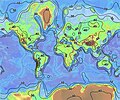 World relief map with isopachs of crustal thickness
 -
 Elemental abundances in Earth's crust
.svg)


