P300 (neuroscience): Difference between revisions
CSV import |
CSV import |
||
| Line 31: | Line 31: | ||
{{neuroscience-stub}} | {{neuroscience-stub}} | ||
{{medicine-stub}} | {{medicine-stub}} | ||
<gallery> | |||
File:P300_latency_and_amplitude_trajectories_across_the_lifespan_as_obtained_from_the_cross-sectional_dataset.png|P300 latency and amplitude trajectories across the lifespan | |||
File:P300_response_of_different_subjects.png|P300 response of different subjects | |||
File:P300_vs_oddballProbability.svg|P300 vs oddball probability | |||
</gallery> | |||
Latest revision as of 03:46, 18 February 2025
P300 (neuroscience)
The P300 is a component of the human event-related potential (ERP) that is elicited in the process of decision making. It is considered to be an electroencephalography (EEG) measure of human cognitive function and is most commonly elicited in an "oddball" paradigm when a person experiences rare, unexpected stimuli.
Overview[edit]
The P300 wave is a positive deflection in voltage with a latency of roughly 250 to 500 milliseconds. The exact latency can vary according to the specifics of the stimuli and task. The P300 is most commonly observed from scalp electrodes overlaying the parietal lobe.
Generation[edit]
The generation of the P300 is thought to involve several cortical and subcortical structures, including the hippocampus, basal ganglia, and thalamus. The exact mechanisms underlying the P300 are still not fully understood, but it is thought to reflect processes involved in stimulus evaluation or categorization.
Clinical significance[edit]
The P300 has been used in clinical contexts to assess cognitive function in various neurological and psychiatric conditions, including Alzheimer's disease, schizophrenia, and depression. It has also been used in forensic contexts, such as in the detection of deception or recognition of familiar stimuli in eyewitness testimony.
See also[edit]
References[edit]
<references group="" responsive="1"></references>

This article is a neuroscience stub. You can help WikiMD by expanding it!

-
 P300 latency and amplitude trajectories across the lifespan
 -
 P300 response of different subjects
 -
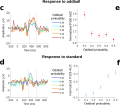 P300 vs oddball probability


