Uterine incarceration: Difference between revisions
CSV import |
CSV import |
||
| Line 38: | Line 38: | ||
[[Category:Pregnancy complications]] | [[Category:Pregnancy complications]] | ||
<gallery> | |||
File:Incarcerateduterus.JPG|Uterine incarceration | |||
File:Retroverted_uterus_in_pregnancy.png|Retroverted uterus in pregnancy | |||
</gallery> | |||
Revision as of 02:13, 18 February 2025
A rare complication of pregnancy
Uterine incarceration is a rare obstetric complication that occurs when a retroverted uterus becomes trapped within the pelvis during pregnancy. This condition can lead to significant maternal and fetal complications if not diagnosed and managed appropriately.
Pathophysiology
In a normal pregnancy, the uterus enlarges and moves out of the pelvis into the abdominal cavity. However, in some cases, a retroverted uterus, which is tilted backward, may become incarcerated in the pelvis. This can occur when the growing uterus becomes wedged between the sacrum and the pubic symphysis.
Symptoms
Symptoms of uterine incarceration can vary but often include:
- Severe pelvic pain
- Difficulty with urination or urinary retention
- Constipation
- Vaginal bleeding
- Abnormal fetal position
Diagnosis
Diagnosis of uterine incarceration is typically made through a combination of clinical examination and imaging studies. Ultrasound is commonly used to assess the position of the uterus and the fetus. In some cases, magnetic resonance imaging (MRI) may be employed for a more detailed evaluation.
Management
Management of uterine incarceration depends on the gestational age and the severity of symptoms. Options include:
- Manual repositioning of the uterus
- Use of a pessary to support the uterus
- Surgical intervention in severe cases
Early diagnosis and intervention are crucial to prevent complications such as preterm labor, uterine rupture, or fetal demise.
Prognosis
With timely and appropriate management, the prognosis for both the mother and the fetus is generally good. However, delayed diagnosis can lead to serious complications.
Related pages
Images


-
 Uterine incarceration
 -
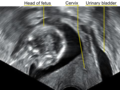 Retroverted uterus in pregnancy
